
 English
 中文

Bulletin
CropWatch bulletinMenu
Authors: Miao,air_panqc | Edit: tianfuyou
During the period from October 2024 to January 2025, soybeans in southern Brazil gradually transitioned from sowing to the growth stage, while maize harvesting in northeastern Brazil has been completed. In the central-south region, the first-season maize shifted from planting to growth stages, and the second-season maize began planting successively; monitoring results will be dynamically updated in subsequent periods.
Remote sensing data indicate that soybean acreage in Brazil reached 43,210.9 thousand hectares, maintaining the trend of expanding soybean planting area, though the year-on-year increase was minimal at only 0.8%. From an agricultural ecological zoning perspective, changes in planting areas were relatively small in key soybean-producing regions such as the Central Savanna (+0.5%), Mato Grosso (+5.5%), and the Parana basin (-0.7%). However, non-key producing regions experienced larger fluctuations in planting area changes.
Although agricultural and climate conditions during the monitoring period deviated significantly from the multi-year average, with rainfall decreasing by 42%, crop drought severity was notably less severe compared to the same period last year, as rainfall increased by 44.1% year-on-year. This improvement was particularly evident during the critical soybean podding stage in mid-January, where rainfall exceeded average levels, ensuring good rain-heat synchronization and favorable conditions for podding. These factors contributed to a significant year-on-year increase in soybean yields, reaching 3.97 tons per hectare, an 11.4% rise compared to the previous year.
From an ecological zoning perspective, regional average yields increased in key producing areas such as the Central Savanna (+20.9%), Mato Grosso (+5.8%), and the Parana basin (+11.6%). Overall, soybean production increased by 12.3% compared to the previous year, reaching 17,158.2 million tons, with an increase of 1,878.9 million tons.
In comparison to soybeans, the planting area for first-season maize in Brazil decreased significantly to 4,214.3 thousand hectares, down 11.1% year-on-year. This reduction may be attributed to consistently low rainfall levels causing farmers to miss the optimal planting window for the first crop of maize.
The average yield for first-season maize reached 7.56 tons per hectare, reflecting a 7.1% increase compared to the previous year, largely due to favorable weather conditions during the maize grain-filling stage. However, the increase in maize yields did not fully offset the substantial reduction in planting area; consequently, first-season maize production decreased by 4.8% compared to the previous year, totaling 3,188.5 million tons and representing a decline of 160.6 million tons.
Overall, during this monitoring period, improved rain-heat conditions led to enhancements in both soybean and maize production in Brazil, primarily reflected in significant increases in yields. Soybeans achieved higher total output by maintaining stable planting areas while improving yields; however, despite increases in maize yields, the reduction in planting areas resulted in a decline in overall maize production.
Considering that most arable land in Brazil is rain-fed, prolonged drought conditions have had a significant impact on maize production. Therefore, it is crucial for the future to focus on enhancing irrigation infrastructure and improving drought resistance to ensure the stability of crop production.
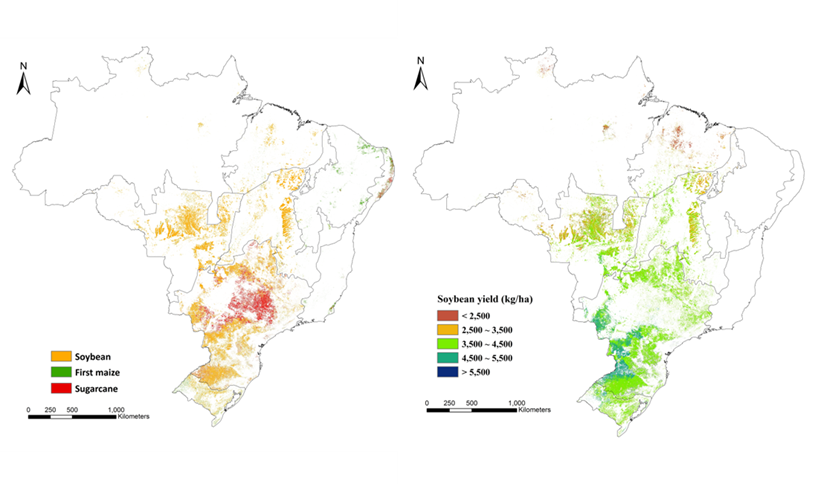
Figure.1 Brazil major crop type map and soybean yield map during October 2024 to January 2025