
 English
 中文

Bulletin
CropWatch bulletinMenu
Authors: tianfuyou,Wangyixuan | Edit: qinxl
Monitoring the growth conditions and early yield formation of major winter wheat production areas in the Northern Hemisphere is of great significance for predicting the global grain market trend. The 12 major wheat-producing regions account for 71% of the global wheat output. Among them, the wheat production areas of the Canadian Prairies and Kazakhstan mainly produce wheat. Therefore, this report focuses on eight major wheat production areas in the Northern Hemisphere.
January to March is the critical period for winter wheat in the Northern Hemisphere to overwinter and turn green. At the beginning of 2025, many places in the Northern Hemisphere experienced abnormal temperature phenomena. Coupled with the fluctuation of global agricultural input prices, this year's winter wheat production faces many uncertainties. Among the eight major wheat production areas, apart from the northern United States, the northern-western mixed cropping area of France, and the Huang-Huai-Hai area of China, which have 5-19% more precipitation than usual, the rest of the production areas have been experiencing hot and dry weather. The precipitation in India and Turkey is more than one time lower than the average level of the past 15 years, which poses a considerable challenge to the greening of wheat in the region.
Overall, the total wheat planting area in the Northern Hemisphere has slightly increased by 0.03%, reaching 10.35 million hectares. However, the overall yield has decreased by 6.3%, to 47,708 kilograms per hectare, and the total output has decreased by 8.3%, to 59.475 million tons. This shows that although the planting area has increased in some areas, the decline in yield has had a significant negative impact on the total output.
In key global wheat production areas, there is a clear difference in the relationship between drought resistance and planting area as well as output. The Huang-Huai-Hai area of China, with its advanced irrigation technology and water-saving measures, has seen a slight decrease in yield. However, the increase in planting area and the extremely low ADAC value (-69.82) demonstrate its excellent drought resistance, and the output is expected to increase slightly compared to the previous year. The northern-western mixed cropping area of France has also shown strong drought resistance, and the increase in planting area and yield reflects the positive impact of efficient irrigation and drought-resistant crop varieties.
However, the Canadian Prairies, Ukraine, Russia, and Romania have higher ADAC values, indicating relatively weaker drought resistance in these areas. In Ukraine, the planting area of wheat in the wheat and corn main production area increased by 8.3% in 2025, reaching 6,223 thousand hectares, but the yield per hectare decreased by 11.0%. The situation in the Central Black Soil Zone and the Caucasus region of Russia is even more serious, with a 21.6% reduction in planting area and an expected 33.0% drop in total output. Although the southern and eastern plains of Romania are facing drought challenges, both the planting area and output in the region have increased. This phenomenon may be related to the drought-resistant measures taken in the region, such as improved irrigation technology and the promotion of drought-resistant crop varieties.
In the northern-central part of India and the central-western part of Turkey, although the yield per hectare has decreased, the increase in planting area and the relatively low ADAC value show that irrigation measures have played a role in alleviating the impact of drought. The drought resistance strategies in these areas need to be further optimized to improve the stability and sustainability of agricultural production.

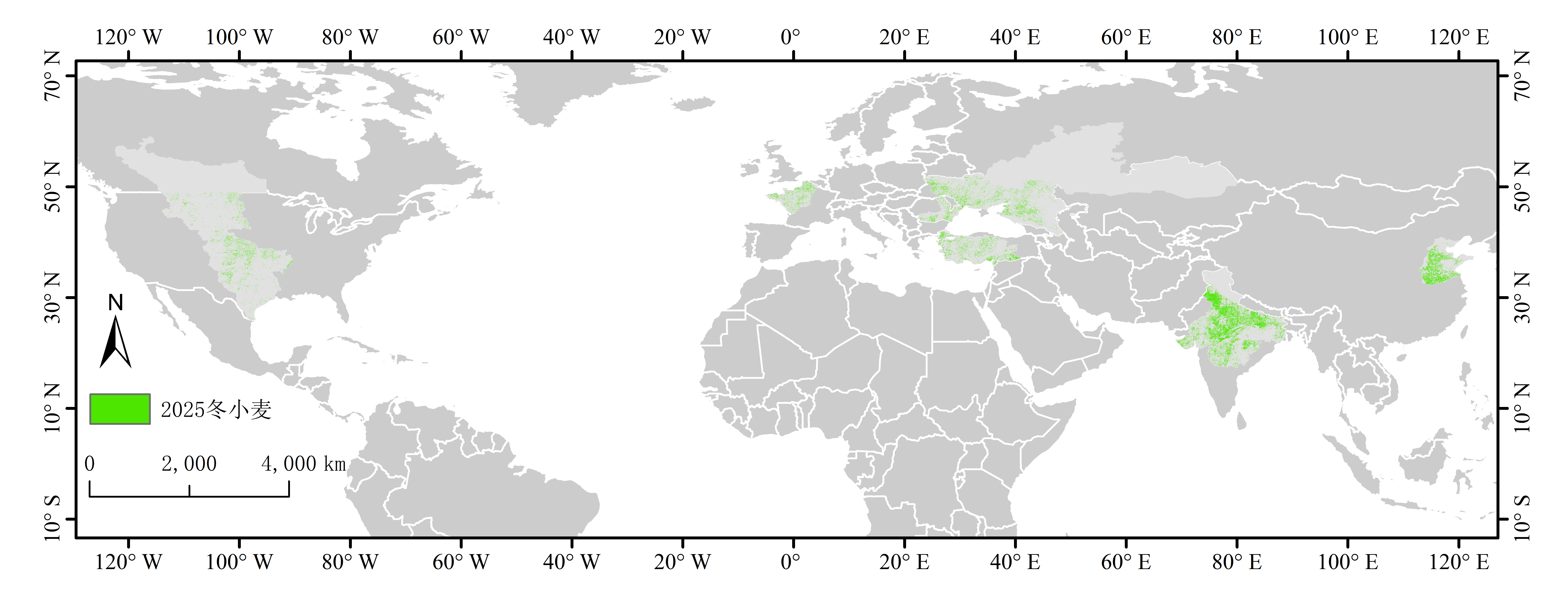
Figure 1. Spatial Distribution Map of winter wheat Planting in 8 main wheat producing areas of the Northern Hemisphere for the 2024/25 Season.
Table1. 2 Winter Wheat Cultivation Area, Yield per Unit Area, and Total Production in 8 main wheat producing areas of the Northern Hemisphere from October 2024 to April 2025
Area (million ha) | Yield (ton/ha) | Production (million tones) | |||||||
2024 | 2025 | Δ% | 2024 | 2025 | Δ% | 2024 | 2025 | Δ% | |
Great Plains Region (United States) | 13.50 | 13.08 | -3.1 | 8.02 | 7.67 | -4.3 | 108.18 | 100.4 | -7.2 |
Huang-Huai-Hai Region (China) | 11.08 | 11.44 | 3.3 | 9 | 8.85 | -1.6 | 99.64 | 101.28 | 1.6 |
North to Central Region (India) | 32.75 | 34.74 | 6.1% | 5.74 | 4.99 | -13.1% | 187.91 | 173.18 | -7.8% |
Major Wheat and Maize Production Region (Ukraine) | 5.75 | 6.22 | 8.3 | 8.56 | 7.62 | -11.0 | 49.18 | 47.4 | -3.6 |
Central Black Earth and Caucasus Region (Russia) | 9.25 | 7.25 | -21.6 | 3.85 | 3.29 | -14.6 | 35.58 | 23.82 | -33.0 |
North-Western Mixed Cropping Region (France) | 4.47 | 4.59 | 2.7 | 7.62 | 7.37 | -3.3 | 34.02 | 33.81 | -0.6 |
Southern and Eastern Plains Region (Romania) | 1.81 | 2.11 | 16.6 | 5 | 5.18 | 3.5 | 9.06 | 10.93 | 20.7 |
Central and Western Region (Turkey) | 8.31 | 8.83 | 6.3 | 3.03 | 2.65 | -12.5 | 25.19 | 23.43 | -7.0 |
Total | 86.90 | 88.26 | 1.6% | 6.31 | 5.83 | -7.7% | 548.76 | 514.25 | -6.3% |