
 English
 中文

Bulletin
CropWatch bulletinMenu
Authors: lirui | Edit: Miao
From May to July 2025, the agricultural production situation in the Northern Hemisphere and tropical regions was slightly better than the normal level. The Crop Production Index (CroPI) in the Northern Hemisphere reached its highest value in the past five years, while the CroPI in tropical regions showed a stable and slightly better pattern. Despite the impacts of localized insufficient precipitation and heatwaves, relatively favorable hydrothermal conditions effectively reduced the risk of water stress in major food-producing countries in the Northern Hemisphere, including the United States, Canada, Central and Western Europe, China, and Russia, thereby ensuring the stability of production conditions. Affected by water resource constraints and extreme weather, the CropPI in North Africa was generally below 0.93, with a severe production situation in north-central Africa; overall precipitation in South Asia was relatively low, and localized waterlogging occurred due to extreme precipitation. The alternation of drought and waterlogging led to a significant reduction in accumulated biomass, and the trend of farmland water stress showed an intensifying pattern.
From the perspective of seasonal characteristics, the global crop production situation from May to July 2025 generally remained above the baseline, but there was a distinct regional differentiation. Drought and high temperatures were the main factors restricting global agricultural production. Against the backdrop of global climate change, frequent extreme drought and flood events pose challenges to food security. Strengthening targeted agricultural management strategies and improving trade transparency are the main measures to balance regional differences in global food supply.
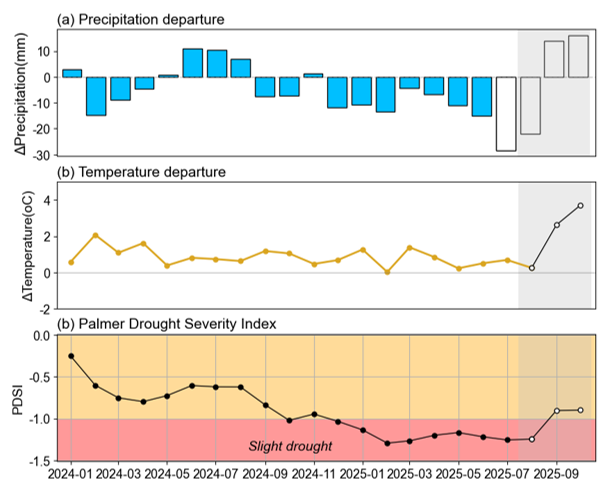
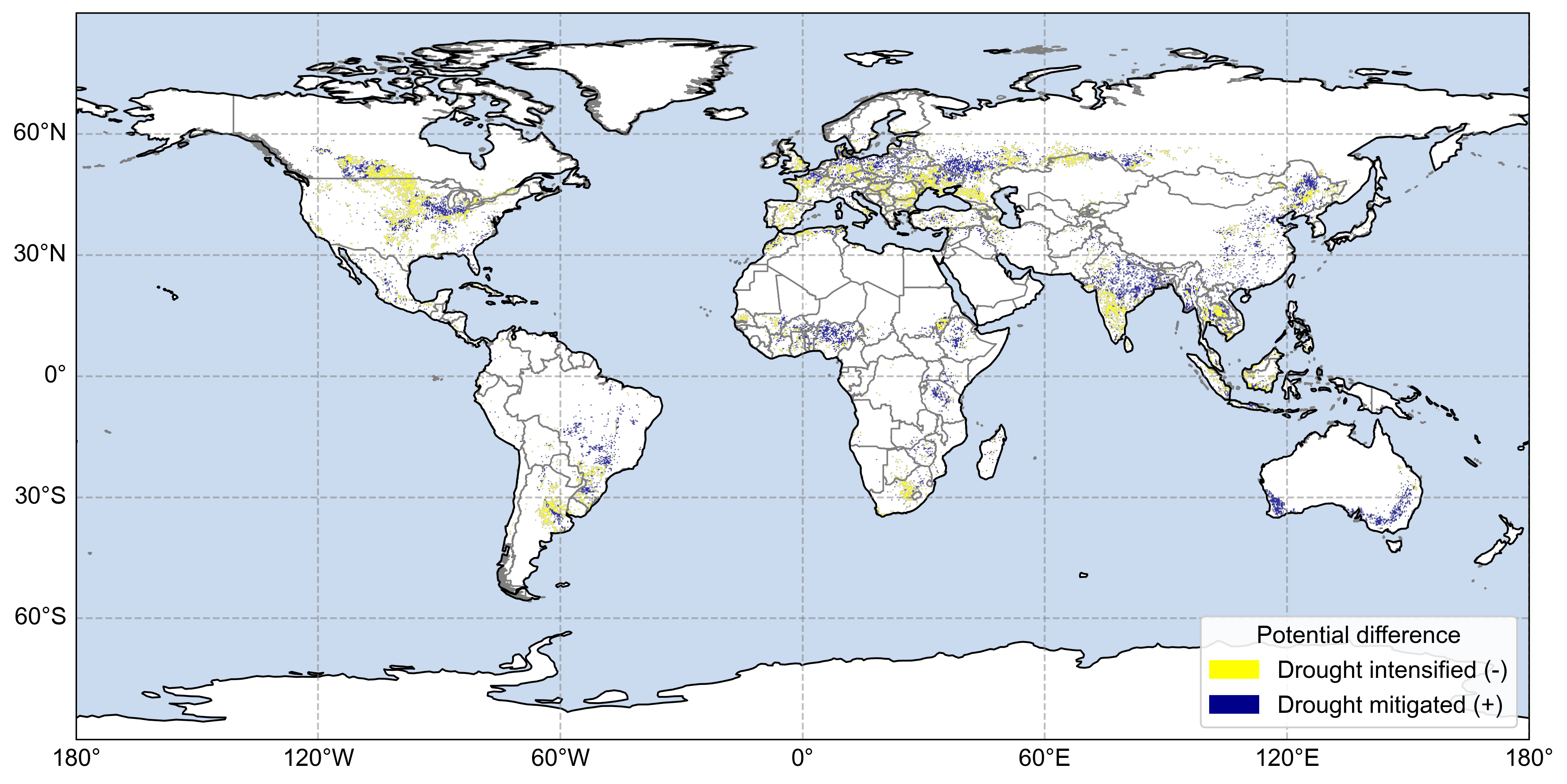
Combined with the short-term forecast for August and the long-term forecast for September–October, the hydrothermal conditions of rain-fed farmland in the next few months will be dominated by high temperatures and heavy rainfall, and the Palmer Drought Severity Index (PDSI) will show a significant alleviation trend from mild drought. Compared with the Palmer Index from May to July 2025, the risk of drought intensification will remain in India, southern Europe, and central North America during August–October (Figure 1.13).
Key areas requiring focus in the future are as follows:
1. Precipitation conditions in water-limited regions, particularly rain-fed agricultural areas where drought is expected to worsen (such as India, southern Europe, and central North America), as well as plains or river valleys with low-lying terrain that are prone to prolonged waterlogging.
2. Sowing progress of winter crops in major agricultural regions of the Northern Hemisphere.
3. Global water resource allocation, especially the water storage capacity of reservoirs and irrigation support capacity in major irrigated agricultural areas.
4. The evolution trend of the global precipitation pattern under the ENSO-neutral state and its potential impacts on agricultural production.
Overall, the main challenges faced by global agricultural production in 2025 are addressing drought and localized flood disasters. It is necessary to strengthen water resource monitoring and early warning, optimize resource allocation, and enhance the climate adaptability and risk resistance of agricultural systems. The global agricultural production situation from May to July 2025 showed a distinct feature of regional differentiation.
(a)
(b)
Figure 1.13 Monthly Variations of PDSI in Global Rain-Fed Agricultural Areas (January 2024–October 2025) (a) and Predictive Analysis of the Difference Between August–October 2025 and May–July 2025 (b)