
 English
 中文

Bulletin
CropWatch bulletinMenu
Authors: lirui | Edit: zenghongwei
Overall, the global Crop Production Situation Index (CroPI) for July-September 2025 stood at 1.06, indicating that agricultural production conditions were generally better than the multi-year average and continued on a stable and improving trajectory. Spatially, global agricultural production exhibited a pattern characterized by "stronger performance in the south versus stability in the north, and better conditions in the east compared to relative weakness in the west": persistent drought in North America was met with overall stability, while southern South America showed robust performance amid constraints in the north; Western Europe remained stable and improving, with favorable conditions in northern Eastern Europe contrasting with weaker performance in the south; drought continued in Africa with localized improvements; production conditions improved in eastern Asia but faced pressure in the south; and Oceania demonstrated outstanding performance in its southeastern part, indicating overall stability with improvement alongside noticeable structural variations. Conversely, parts of East Asia were affected by prolonged overcast and rainy weather, leading to localized waterlogging which impacted the autumn harvest.
Based on short-term forecasts for October and long-term forecasts for November-December, global rain-fed farmland is expected to face a climate pattern marked by significant precipitation fluctuations and higher-than-average temperatures in the coming months (Figure 1.12). The Palmer Drought Severity Index indicates that mild drought conditions in global rain-fed agricultural areas are persisting. Compared to the July-September 2025 period, drought conditions are anticipated to develop further across most of North America, central Asia, and Northeastern China. However, as this period coincides with the winter fallow season, the actual impact on agricultural production is expected to be limited. In contrast, Southern South America and Southern Africa will successively enter the critical growth stages for their main crops, where the risk of agricultural drought may intensify, necessitating focused prevention efforts.
Key Areas for Future Focus:
Precipitation Changes in Water-Limited Regions: Close monitoring of precipitation changes in water-limited regions is crucial, particularly in key agricultural zones such as Southern South America and Southern Africa .
Spring Crop Sowing in the Southern Hemisphere: Attention must be paid to the sowing progress of spring crops in the major agricultural regions of the Southern Hemisphere.
Global Water Resource Allocation: The status of global water resource allocation requires assessment, especially the reservoir storage levels and irrigation security capabilities in major irrigated areas.
Differential Impacts of ENSO: The global precipitation anomalies triggered by the weak ENSO La Niña event and their differential impacts on major agricultural regions need focused evaluation.
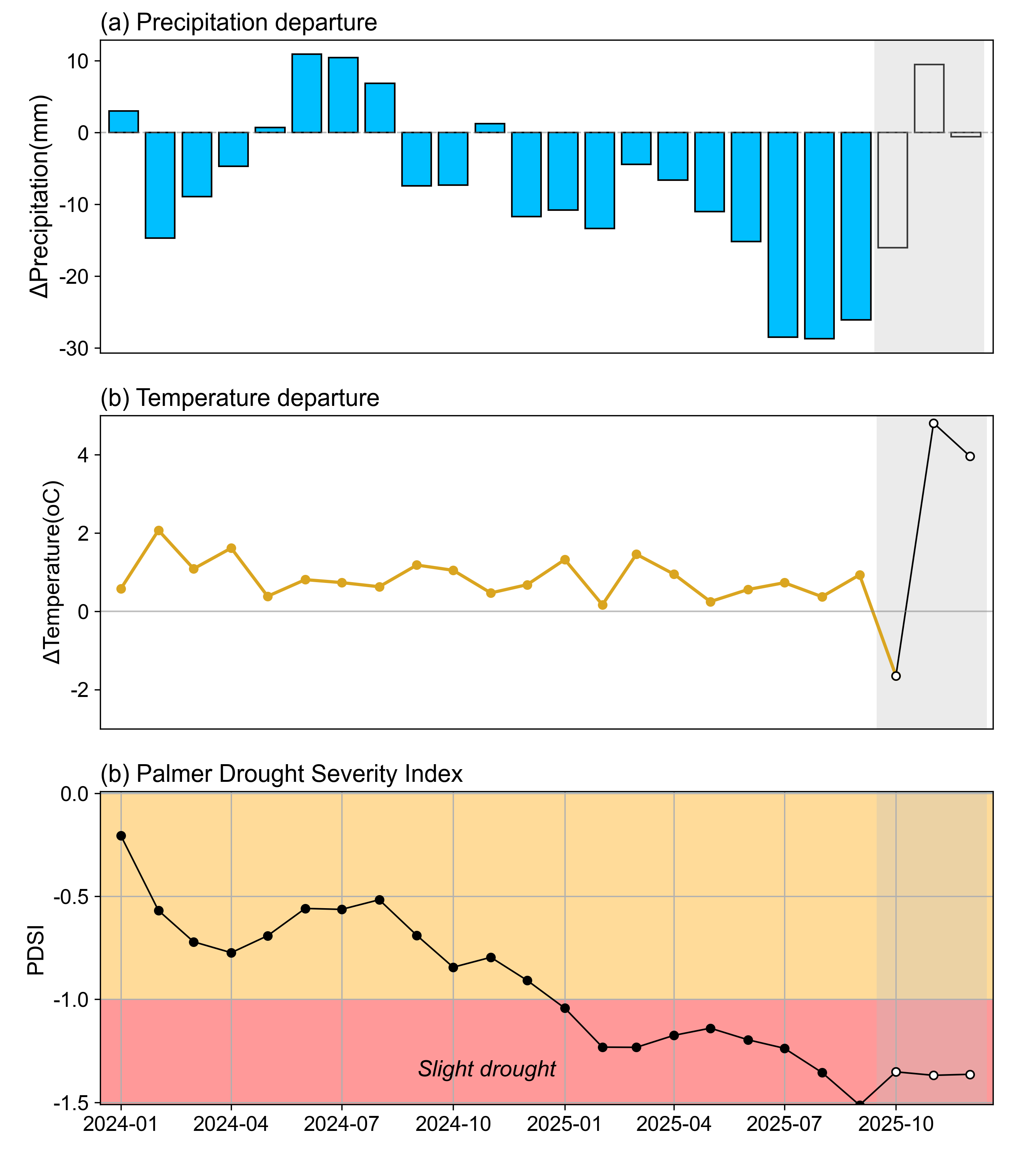

Figure 1.12 (a) Monthly Changes in the Palmer Drought Severity Index (PDSI) for Global Rain-fed Agricultural Areas (January 2024 - December 2025); (b) Predictive Analysis of the Difference Between October-December 2025 and July-September 2025