
 English
 中文

Bulletin
CropWatch bulletinMenu
Authors: qinxl | Edit: qinxl
During July–September 2026, rice production across the equatorial and adjacent rice-growing regions presented a pattern of "continued area contraction, broad yield recovery, and moisture limitation giving way to light limitation". The tropical Crop Production Index (CroPI-7) was 1.08, above the baseline and clearly recovered from the 1.01 of the same period last year; the below-par tropical value of 0.96 in the previous period (May–July) was reversed this period. Spatially, the two contiguous below-par belts of the previous period — most of South Asia–Indochina and West Africa–the Gulf of Guinea — contracted into two point-like low-value areas: the northwestern arid agricultural zone of South Asia and the northern fringe of the West African Sahel. The main rice zones of the Indochinese Peninsula returned to near the baseline to slightly above; the Ganges Plain was mostly at or slightly above the baseline; and the main island agricultural areas of Southeast Asia remained near the baseline. The agroclimatic background was consistent with the spatial pattern: rainfall on the Ganges Plain was near to above average; the Indochinese Peninsula had above-average rainfall and below-average PAR; and the Malay Archipelago and the Sahel continued to receive below-average rainfall (Figure 1.11).
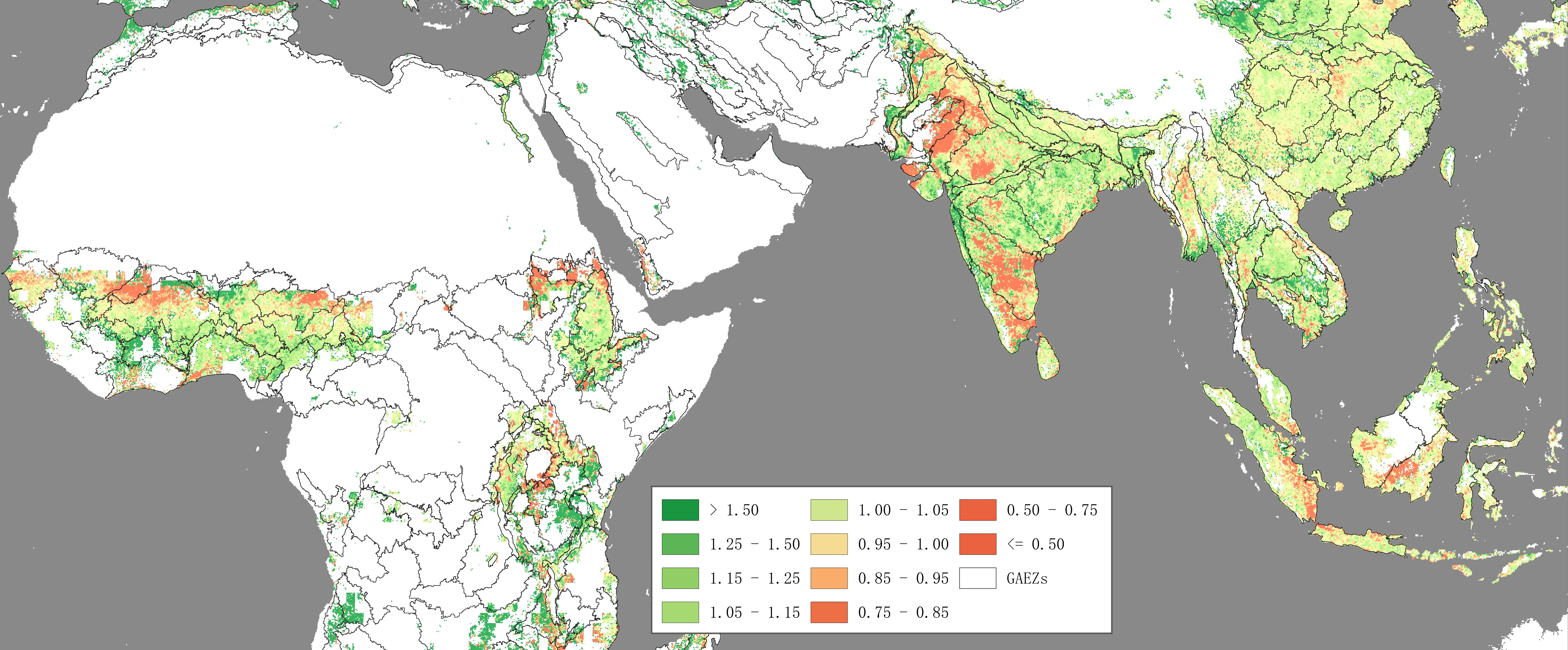
Figure 1.11 Spatial distribution of the Crop Production Index (CroPI-7) across the equatorial and adjacent rice-growing regions, July–September 2026
The South Asian rice zones were at the post-transplanting growth of Bangladesh's Aman season and the vigorous growth to yield formation of India's Kharif season; the earlier sowing delay had turned into recovery growth. Bangladesh's Aman-season yield and production were revised down by 8.0% and 8.1% respectively from the August forecast, while the Aus-season reassessment was revised up by 14.7%; CALF was 98% and CroPI-7 1.16, with drought conditions markedly alleviated relative to the previous period. India's Kharif-season rice yield rose 9.0% year-on-year, with production of 227.10 million tonnes (+6.4% year-on-year); CALF shifted from 26% below average to 2% above, and VCIx rose from 0.68 to 0.93 — the most pronounced recovery in this section — yet internal contrasts remain: the northwestern arid agricultural zone is the main concentration of low values (some areas below 0.75), and the eastern and western coastal areas received rainfall 11%–18% below average, with potential biomass 16%–21% below.
The Southeast Asian rice zones were at the tillering–jointing to booting–heading stages of the main wet-season rice, while double-cropping zones such as the Mekong Delta combined the summer–autumn rice harvest with the establishment of autumn–winter rice, presenting a situation of "turning-wet rainfall, weak sunshine, and modest yield gains". Thailand's main-season rice yield rose 2.5% year-on-year, with production of 23.40 million tonnes (+2.1% year-on-year); rainfall was 12% above average while PAR was 14% below. In the previous period, under rainfall deficits, the Agricultural Drought Area Change Index (ADAC) reached −97.1%; after rainfall replenishment this period, meteorological drought was largely eliminated and the index returned to −7.0%, with the moisture deficit in the single-cropping rainfed rice zones of the Northeast largely lifted. Vietnam's yield rose 3.7% year-on-year, offsetting the 3.5% area decline and leaving production on par with the same period last year; ADAC was −47.1%, with irrigation and rainfall replenishment alleviating nearly half of the local meteorological drought, and the Palmer Drought Severity Index stood at −1.27 — a moisture deficit clearly more pronounced than Thailand's.
The equatorial island rice zones were at a parallel stage of post-harvest for the main-season rice and growth of the second dry-season crop in irrigated double-cropping zones. Indonesia's rice area fell 4.7% year-on-year, yield rose 3.8%, and production was 5.873 million tonnes (−1.1% year-on-year), with the area contraction the main driver of the production decline; accumulated rainfall was only 111 mm, 71% below average; temperatures were 1.1°C above average and PAR 7% above; and potential accumulated biomass fell 43% — the most prominent case of moisture deficit among the world's major rice-producing countries. Light and heat conditions and irrigation support jointly underpinned the modest yield gain, with moisture pressure most concentrated in the rainfed rice zones and in fields at the tillering–jointing stage.
Overall, rice production in the five producing countries this period shared the pattern of area contraction coexisting with yield recovery: apart from Bangladesh, for which no comparable baseline period exists, the other four countries saw year-on-year area declines of 0.3%–4.7% and yield gains of 2.5%–9.0%. Production was dominated by yield: Thailand and Vietnam held or slightly increased production; India achieved a 6.4% year-on-year production increase through a large yield gain; and Indonesia was the only country whose production still declined, as shown in Table 1.5. The previous period's differentiation pattern, centered on moisture deficits, was this period rearranged by sunshine conditions: rainfall on the Indochinese Peninsula turned above average and radiation was 8%–14% below, so that moisture was no longer the main factor limiting yield formation; Indonesia was the opposite — a large rainfall deficit with ample light and heat, where the degree of irrigation support directly determines whether yields can be maintained. As for the degree to which meteorological drought was alleviated without developing into agricultural drought, ranked by ADAC: Indonesia (−79.8%) was the strongest, followed by Vietnam (−47.1%) — consistent with the background of still-pronounced meteorological drought in both countries this period, where the buffering role of irrigation and rainfall replenishment was also the most significant; the indices for India (−14.2%), Thailand (−7.0%) and Bangladesh (0.0%) were close to zero, consistent with the background of relatively light meteorological drought itself this period.
Table 1.5 Rice production in selected countries of the equatorial rice-growing regions (July–September 2026)
Country | Planted area (thousand ha) | Yield (kg/ha) | Production (million tonnes) | ||||||
2025 | 2026 | Change (%) | 2025 | 2026 | Change (%) | 2025 | 2026 | Change (%) | |
Bangladesh† | — | 5,958 | — | — | 3,590 | — | — | 21.39 | — |
India‡ | 44,158 | 43,101 | −2.4 | 4,833 | 5,269 | +9.0 | 213.42 | 227.10 | +6.4 |
Indonesia§ | 1,575 | 1,502 | −4.7 | 3,768 | 3,911 | +3.8 | 5.94 | 5.873 | −1.1 |
Thailand¶ | 5,520 | 5,503 | −0.3 | 4,150 | 4,252 | +2.5 | 22.91 | 23.40 | +2.1 |
Vietnam†† | 1,821 | 1,757 | −3.5 | 3,602 | 3,734 | +3.7 | 6.56 | 6.562 | +0.03 |
Notes: † Bangladesh: Aman-season monitoring results; no same-season monitoring value exists for the same period of 2025. Its yield and production were revised down by 8.0% and 8.1% respectively from the August forecast; the Aus-season reassessment results (1,008 thousand ha, 3,896 kg/ha, 3.93 million tonnes) are not included in this table. ‡ India: Kharif-season monitoring results. § Indonesia: dry-season rice monitoring results. ¶ Thailand: main rainy-season monitoring results. †† Vietnam: summer–autumn rice and northern summer rice monitoring results.
In the next monitoring period, India's Kharif-season rice will enter grain filling–maturity and be harvested in October–November; Bangladesh's Aman season will enter heading–grain filling and be harvested in November–December; Thailand's main rainy-season rice will be harvested in November–December; the autumn–winter rice of southern Vietnam will be growing in the field; and Indonesia will turn to next-season sowing. The El Niño event is expected to maintain strong-to-very-strong conditions into early 2027; its teleconnection provided favorable moisture conditions for South and Southeast Asian rice during August–October, with the risk correspondingly shifted back to the sowing-period soil moisture and irrigation water supply of the next season.