
 English
 中文

Bulletin
CropWatch bulletinMenu
Authors: Wangyixuan | Edit: qinxl
During the monitoring period from July to September 2026, Argentina experienced generally drier and cooler conditions, with rainfall 31% below the 15-year average, average temperatures 0.5°C below average, and PAR 10% below average. The combined effects of insufficient rainfall, lower temperatures, and reduced solar radiation adversely affected biomass accumulation, with potential biomass decreasing by 20% relative to the 15-year average. In the Humid Pampas, a major wheat-producing region, precipitation was 36% below average, PAR was 9% below average, and potential biomass decreased by 22%. In the Dry Pampas, precipitation was 28% below average, PAR was 9% below average, and potential biomass declined by 16%. Despite the unfavorable agroclimatic conditions, CALF reached 80%, 23% above the five-year average. The maximum VCI was 0.86, CroPI reached 1.46, ADAC was -97.0%, PDSI was -0.13, and CWSI was 1.98. NDVI across Argentina and the major agricultural regions of the Pampas generally remained near or above the five-year average, indicating that vegetation conditions on most cultivated land were still favorable and that temporary rainfall deficits had not resulted in widespread deterioration of crop conditions nationwide.
Argentina's wheat area in 2026 was estimated at 6.42 million hectares, down 6.76% from 6.880 million hectares in 2025. Yield declined slightly by 0.74% to 3.504 t/ha, resulting in production of about 22.480 million tonnes, 7.44% lower than the 24.286 million tonnes produced in 2025. The decline in production was primarily driven by reduced wheat area, while yields remained relatively stable. According to the Rosario Board of Trade (BCR), rising agricultural input costs, particularly fertilizer prices, and narrowing profit margins ahead of the 2026 planting season affected farmers' wheat planting decisions in some regions. In terms of weather conditions, persistent high humidity and limited sunshine in parts of the country during July and August, followed by insufficient rainfall in key agricultural regions in September, caused some water stress during critical wheat growth stages, including stem elongation and heading. However, soil moisture reserves accumulated earlier in the season, together with rainfall in some areas in early October, helped alleviate localized drought stress, and wheat conditions remained generally favorable across most major producing regions. Overall, Argentina's wheat production in 2026 was characterized by a moderate contraction in wheat area, relatively stable yields, and a slight decline in total production. Rainfall, low temperatures, and sunlight availability during the subsequent grain-filling stage remain important factors influencing final wheat yields.
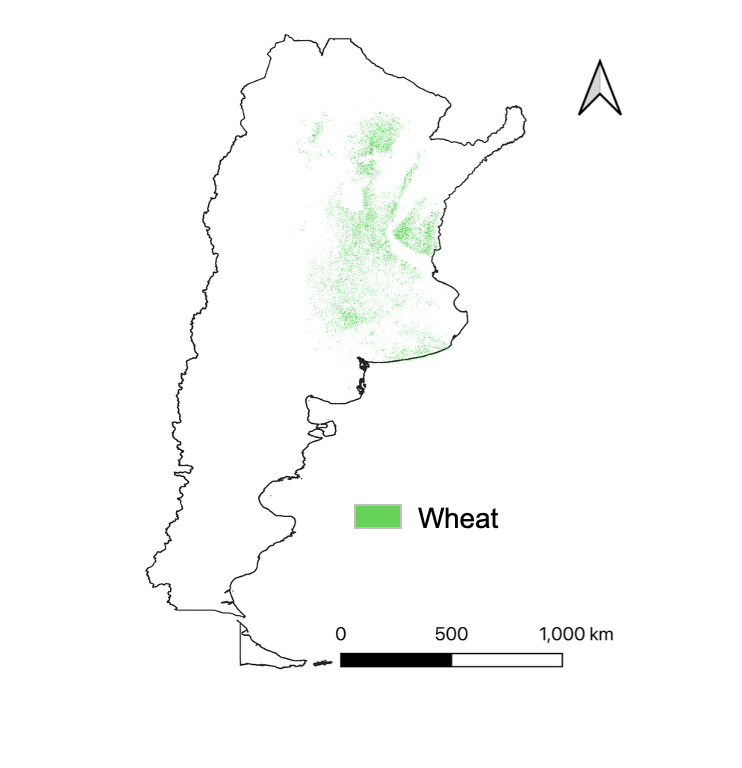
Figure 2.1 Argentina wheat map in 2026