
 English
 中文

Bulletin
CropWatch bulletinMenu
Authors: Miao,abduldang | Edit: qinxl
This report presents CropWatch monitoring of the 2026 wet-season first-season maize in northern Nigeria for July–September 2026, covering late growth, grain filling and the start of harvest, together with a yield update for the north and for the country as a whole. The August report had estimated the planted area at about 3.3 million hectares, 29% below the multi-year average, and the yield at 2300 kg/ha, following a late, rain-deficient start to the season. The July–September indicators confirm that the early-season rainfall shortfall persisted, but they also show crop vigor recovering strongly in the later part of the season.
National agroclimatic indicators depict a dry, hot season. Accumulated rainfall (RAIN) was 299.9 mm, a −44.49% departure from the 15-year average; air temperature (TEMP) averaged 27.5°C, +1.51°C above average; radiation (RADPAR) was 812.5 MJ/m², +6.88% above average but unusable under moisture limitation; and potential biomass (BIOMSS) was 978.9 g/m². Within the season, rainfall was erratic: only about 16 mm in July against an average of about 41 mm, a peak of about 97 mm in late August, and about 39 mm in the last dekad of September against a normal of about 52 mm — an early cessation that threatens late-sown maize still filling grain. Heat peaked in July (29.1°C) and again in September (27.9°C), the latter coinciding with grain filling and maturity. Across the original northern maize area, the stress was concentrated in the Sudan Savannah (RAIN 237.6 mm, −52.31%; TEMP +1.67°C) and the Guinea Savannah (RAIN 386.5 mm, −39.80%; TEMP +1.23°C), while conditions were milder on the Jos Plateau (−20.53%) and in the Derived Savannah (−18.32%); the Sahel Savannah was the driest (−73.08%) but lies largely north of the maize belt.
Crop condition was nevertheless better than rainfall alone would suggest. NDVI in the north rose from about 0.37 in late June to about 0.45 in mid-July and tracked the 5-year average through August, before reaching about 0.61 in mid-September — above both the 5-year average (about 0.56) and the 5-year maximum (about 0.57), most likely because late-sown fields reached canopy closure simultaneously. NDVI cluster analysis captured dry-spell dips in late July and August, but by mid-September all clusters showed positive departures (about +0.02 to +0.06). The national maximum Vegetation Condition Index (VCIx) was 0.85: most cropped pixels in the northwest, north-central and middle-belt areas fell in the 0.8–1.0 class, values exceeded 1.0 on the Jos Plateau and in the Guinea Savannah, and the weakest conditions (0.5–0.8, with patches below 0.5) were confined to the Sahelian northeast around Borno and Yobe. The Crop Production Index (CroPI) for June–September was 1.08 — the highest in the 2021–2026 series and above the 5-year average of 1.02, an improvement on the 0.939 reported in August.
The maize yield maps support a modest upward revision. Maize is scattered across the northwest and north-central belt, and map-based yields range from about 1,626 to 5,367 kg/ha, with higher values in the north-central savanna where VCIx exceeded 1.0. The northern first-season maize yield is accordingly revised to about 2,450 kg/ha, 6.5% above the August estimate; applied to the August planted area of 3.3 million hectares, this implies production of about 8.1 million tonnes. The national maize yield is estimated at about 2,500 kg/ha.
Overall, the season ends better than the early indicators suggested but remains below normal, as the reduced planted area still caps total output. The main risks in the north are terminal moisture stress in late-sown crops after the early end of the September rains, heat-related effects on grain quality, and uneven harvest conditions where recovery came late. In the south, excess rainfall (Lowland Rainforest +26.88%) raises disease and post-harvest drying risks, and the second-season outlook there warrants continued monitoring.
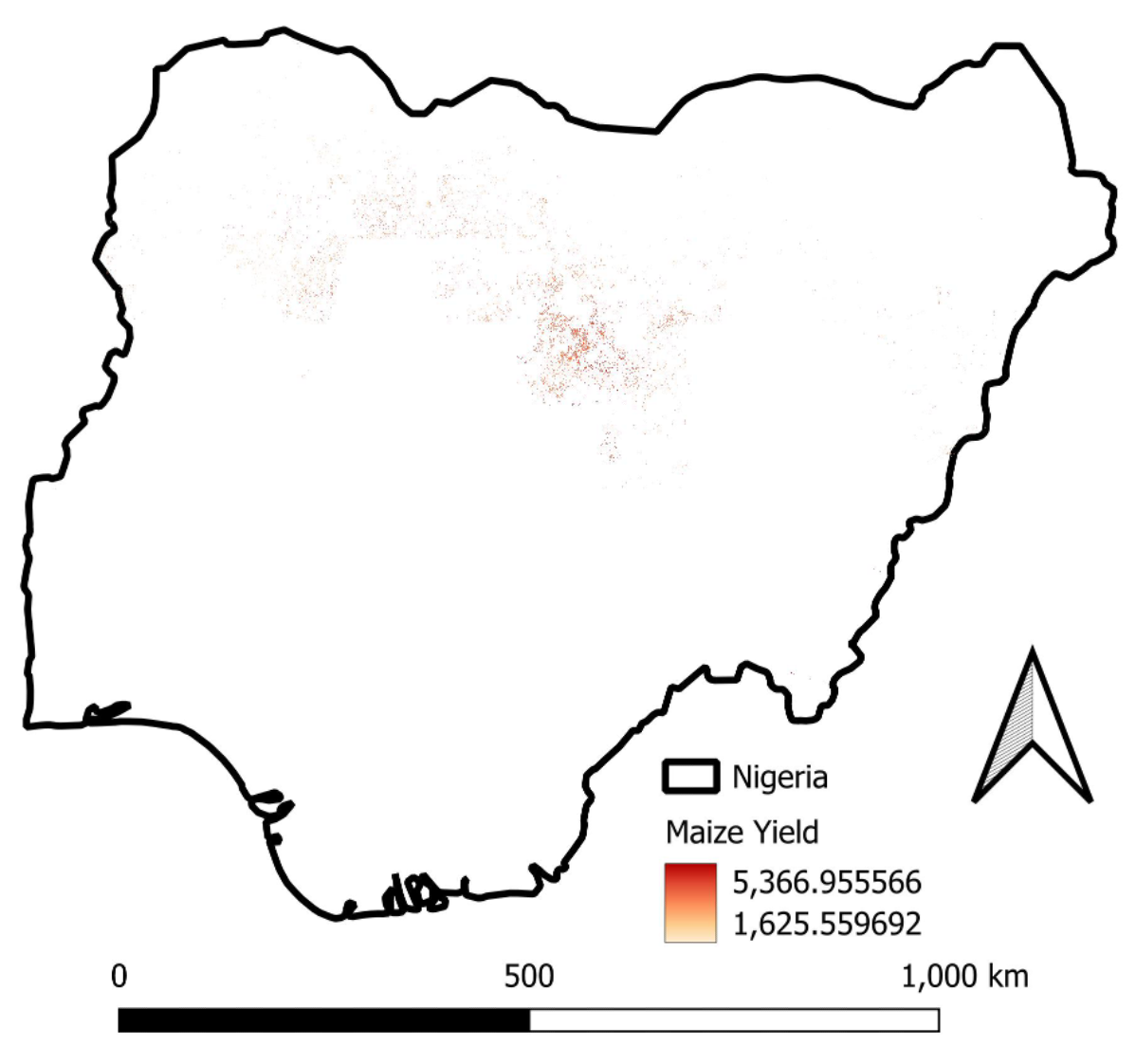
Figure.1 Maize yield distribution in northern Nigeria