
 English
 中文

Bulletin
CropWatch bulletinMenu
Authors: qinxl | Edit: qinxl
Wheat is the overwhelmingly dominant grain crop in Russia, accounting for more than half of the country's sown area of cereals, with production dominated by winter wheat. The other crops — barley, maize, sunflower and soybean — are all spring-sown and autumn-harvested with relatively small areas; by the current monitoring window the harvest in the western main producing regions had largely finished, and the crops entering the autumn-sowing period are dominated by winter wheat. This period, Russia's monitoring focus shifts to the autumn-sowing conditions and early growth of the 2026/27 winter wheat. Combining multi-temporal satellite imagery up to October 20 with water–heat data for October 12–16, an integrated analysis was made of post-harvest vegetation changes and soil moisture conditions in the main autumn-sowing regions of western Russia. Monitoring shows that new-growth signals have appeared on some cropland in the Central Black Earth region and the middle Volga, while the Caucasus remains dominated by the post-harvest low-cover state; surface soil moisture is low in the middle Volga and the Southern Caucasus — the autumn-sowing environmental issue currently warranting focused attention.
This period takes the seven agroecological zones of western Russia as monitoring units, randomly samples within the cropland extent, and uses multi-temporal satellite imagery to track post-harvest vegetation changes. Changes that showed greening after a low-cover state and were confirmed by subsequent observations are taken as signals that sowing has possibly occurred and growth has begun, while unconfirmed new growth and insufficient observations are retained as separate categories. Combined with the soil moisture and temperature corresponding to each cropland category, the water–heat conditions for sowing, emergence and early growth are analyzed.
Among the monitored cropland, the proportions showing post-harvest new-growth signals were about 14.5% in both the Central Black Earth region and the middle Volga, and about 10.1% and 10.6% in Central Russia and the Urals–Volga region, respectively (Figure 2.18). The corresponding proportions in the Northern and Southern Caucasus were about 7.0% and 2.9%; in these two zones, roughly 70% of the monitored cropland remains in low cover without clear new-growth signals. Such cropland may be awaiting sowing, or sown but not yet forming appreciable vegetation cover. The autumn-sowing window in the south is relatively late, so the currently low vegetation cover cannot yet be interpreted as a sowing delay.
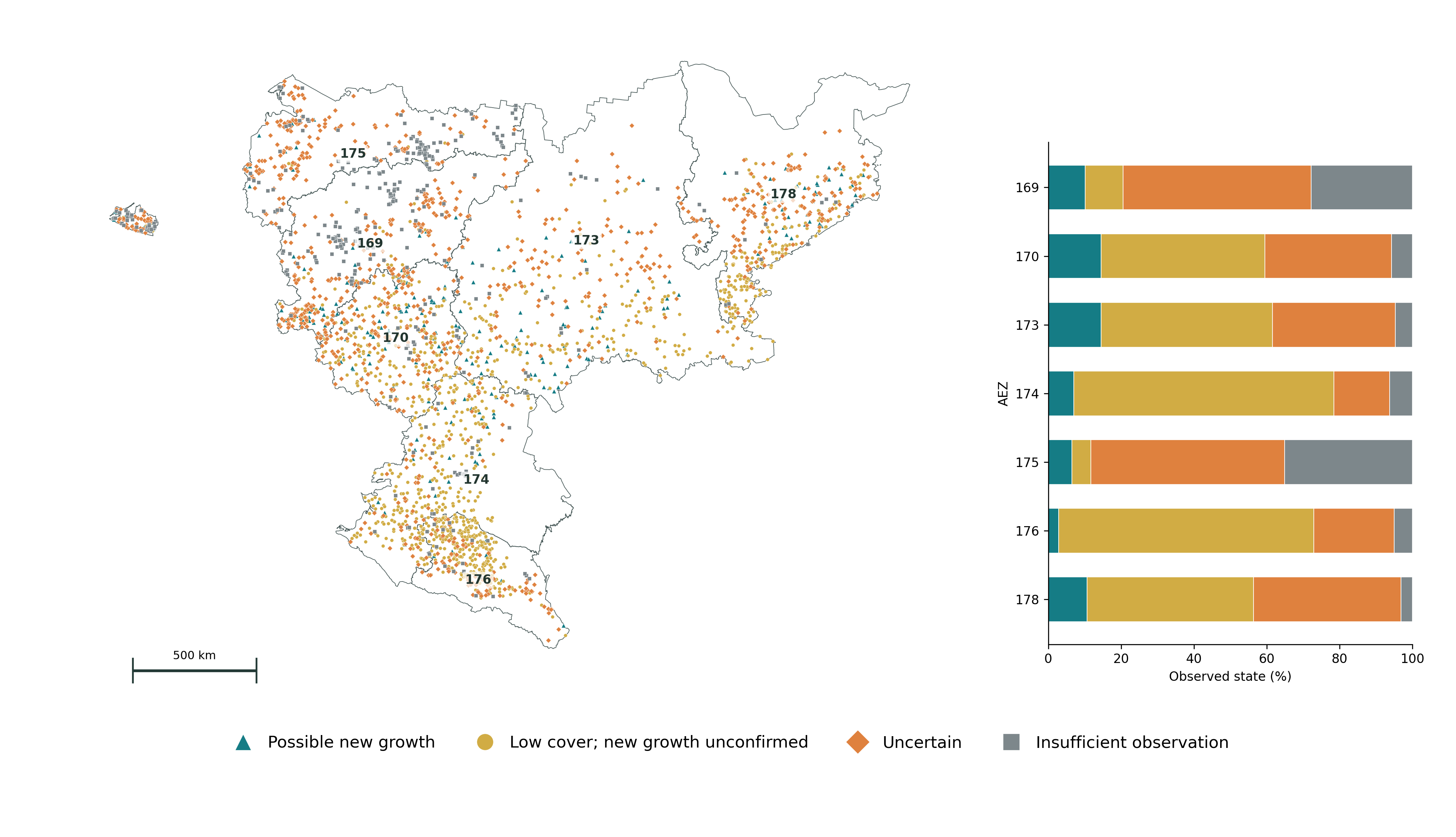
Figure 2.18 Distribution of the post-harvest vegetation status of cropland in western Russia and status composition by agroecological zone
Zone numbers: 169, Central Russia; 170, Central Black Earth; 173, middle Volga; 174, Northern Caucasus; 175, Northwestern Russia; 176, Southern Caucasus; 178, Urals–Volga.
The moisture shortage in the middle Volga affects both cropland with new growth and cropland still in low cover. Compared with the same-period averages for 2021–2025, the surface soil volumetric water content corresponding to the two cropland categories was about 0.054 and 0.065 m³/m³ below average, respectively, while the same-period temperature was about 16°C, roughly 8°C above average (Figure 2.19 and Figure 2.20). Under such warm conditions, moisture replenishment is especially important for subsequent growth: for cropland with new growth, attention is needed on whether early growth can be sustained; for low-cover cropland, on the soil moisture conditions required for sowing and germination. Both cropland categories sit against a dry background, indicating that the moisture problem is not confined to areas where new growth has not yet been observed.
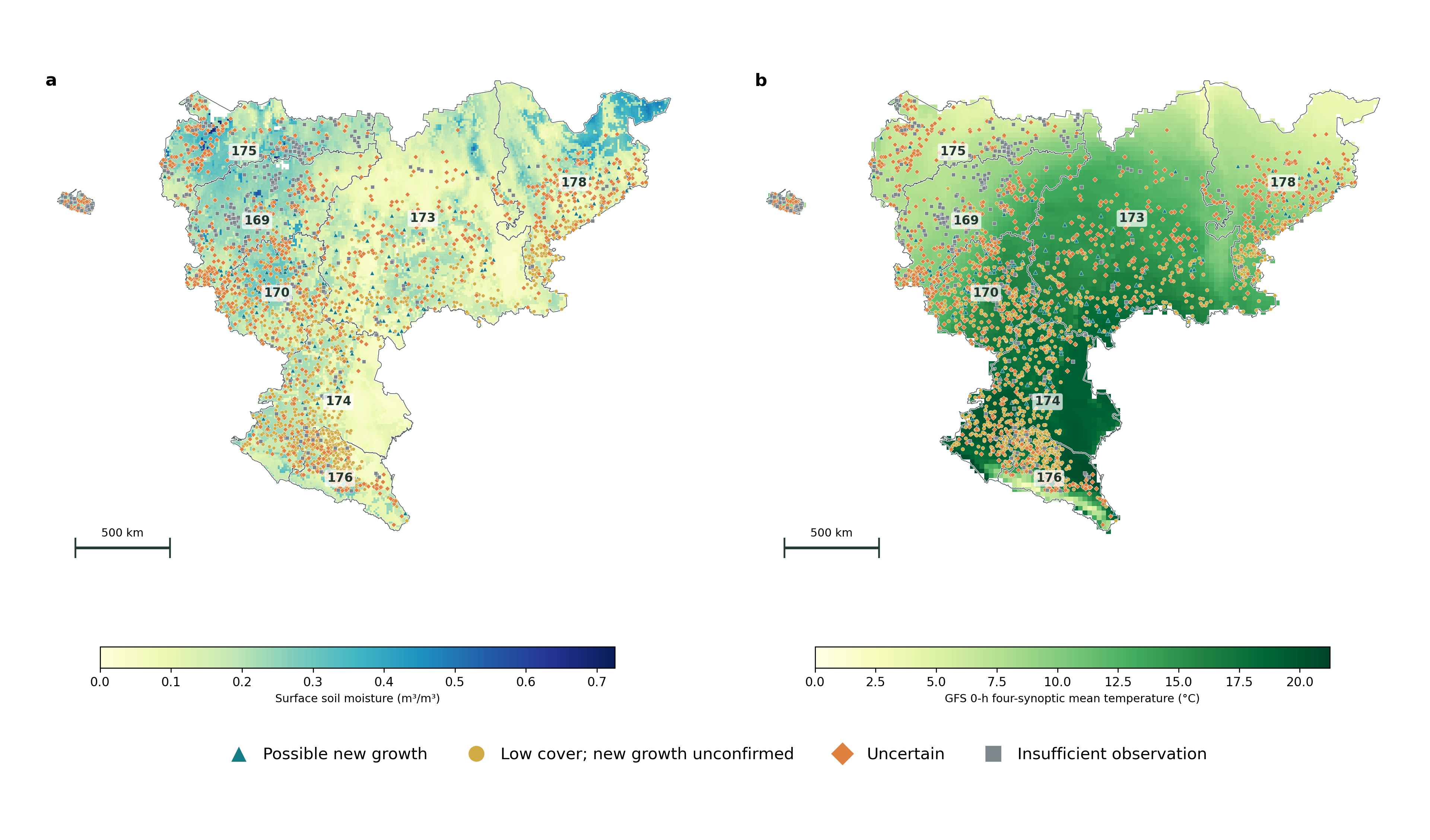
Figure 2.19 Spatial distribution of surface soil moisture (a) and air temperature (b) in western Russia (October 12–16, 2026)
The Southern Caucasus likewise shows warm conditions with low surface soil moisture. The average temperatures corresponding to cropland with new growth and to low-cover cropland were both 18–19°C, about 6°C above the same-period average of the last five years, and the surface soil volumetric water content was about 0.05 m³/m³ below average in both cases (Figure 2.20). Given the high share of low-cover cropland in this zone, subsequent effective rainfall will play an important role in improving the conditions for sowing and emergence. The Northern Caucasus is also warm and dry; in the Central Black Earth region, the surface soil moisture of the two cropland categories was about 0.010 and 0.015 m³/m³ below average, respectively — smaller negative deviations than in the middle Volga, though soil moisture changes under the warm conditions still warrant attention.
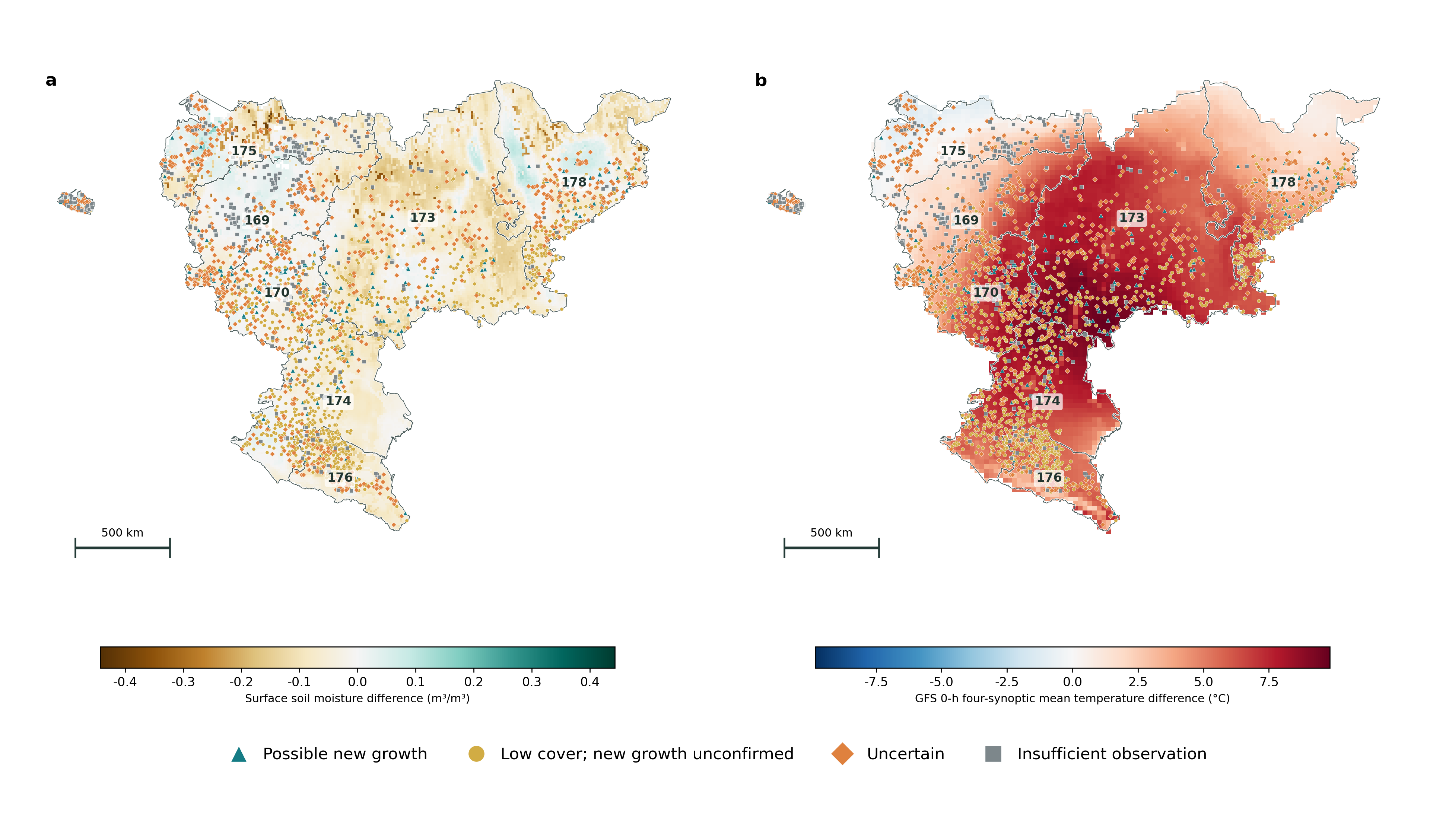
Figure 2.20 Differences of surface soil moisture (a) and air temperature (b) in western Russia from the 2021–2025 same-period averages (October 12–16, 2026)
Northwestern Russia differs from the southern regions in its water–heat status: the surface soil moisture corresponding to cropland with new growth was slightly above the same-period average of the last five years, temperatures were close to the same-period level, and the warm–dry combination seen in the south did not appear. However, for parts of the cropland in the Northwest and in Central Russia, the early-growth status remains unclear owing to insufficient valid satellite observations and ambiguous vegetation changes; a scarcity of new-growth signals alone should not be taken as evidence of slow autumn-sowing progress.
Overall, the new-season autumn-sowing environment in western Russia shows marked regional differences, and moisture replenishment in the middle Volga and the Southern Caucasus should be the focus of subsequent monitoring. Without effective rainfall, the low surface soil moisture may restrict post-sowing germination and early seedling growth; a timely improvement in soil moisture would support sowing, emergence and pre-overwintering crop establishment. Continued tracking of rainfall replenishment, soil moisture recovery and changes in the extent of new growth in these areas is needed going forward.