English
 中文
中文
Bulletin
CropWatch bulletinMenu
Authors: 超级管理员 | Edit: tanshen
2.6 Western Europe
At the scale of the MPZ, crop condition was average in the Western European MPZ during this reporting period, with these average conditions resulting from a combination of negative and positive extremes. The figures present an overview of CropWatch agroclimatic and agronomic indicators for this MPZ.
The agroclimatic indicators show that total rainfall across the MPZ (as measured with the RAIN indicator) was 3% below average, resulting from marked negative departures in large parts of the Mediterranean region throughout the monitoring period and also including most of the United Kingdom, Germany, Denmark, the Czech Republic, Slovakia, Austria, and Hungary in late August and mid-October. The most severely affected three countries were Spain (RAIN, -53%), France (-42%), and Italy (-25%). All countries will need more rain in the coming weeks to raise soil moisture levels, allow seedbed preparation, and create favorable conditions for the germination and emergence of newly sown crops. The rainfall deficit was most severe in southern France and western Italy, where sowing activities usually start in November.
Exceptional positive RAIN departures were recorded (1) over most of the United Kingdom, Germany, Denmark, the center and west of the Czech Republic, western Austria, and eastern Hungary from mid-July to mid-August, early September to early October, and late October, and also (2) east of the Czech Republic, center and east of Austria, southwest Slovakia, and most of Hungary from late July to mid-August, early September to early October, and late October. In large parts of the northern region of this MPZ, the sowing of winter crops, already delayed by the late harvesting, was further hampered by excessively wet conditions.
Temperature (TEMP) was average for the MPZ as a whole, but radiation was below average with RADPAR at -5%. Below average temperatures were observed in most parts of the MPZ from late July to early October, with the exception of Spain. However, heatwaves in Mediterranean regions and eastern parts of the MPZ continued until the end of August.
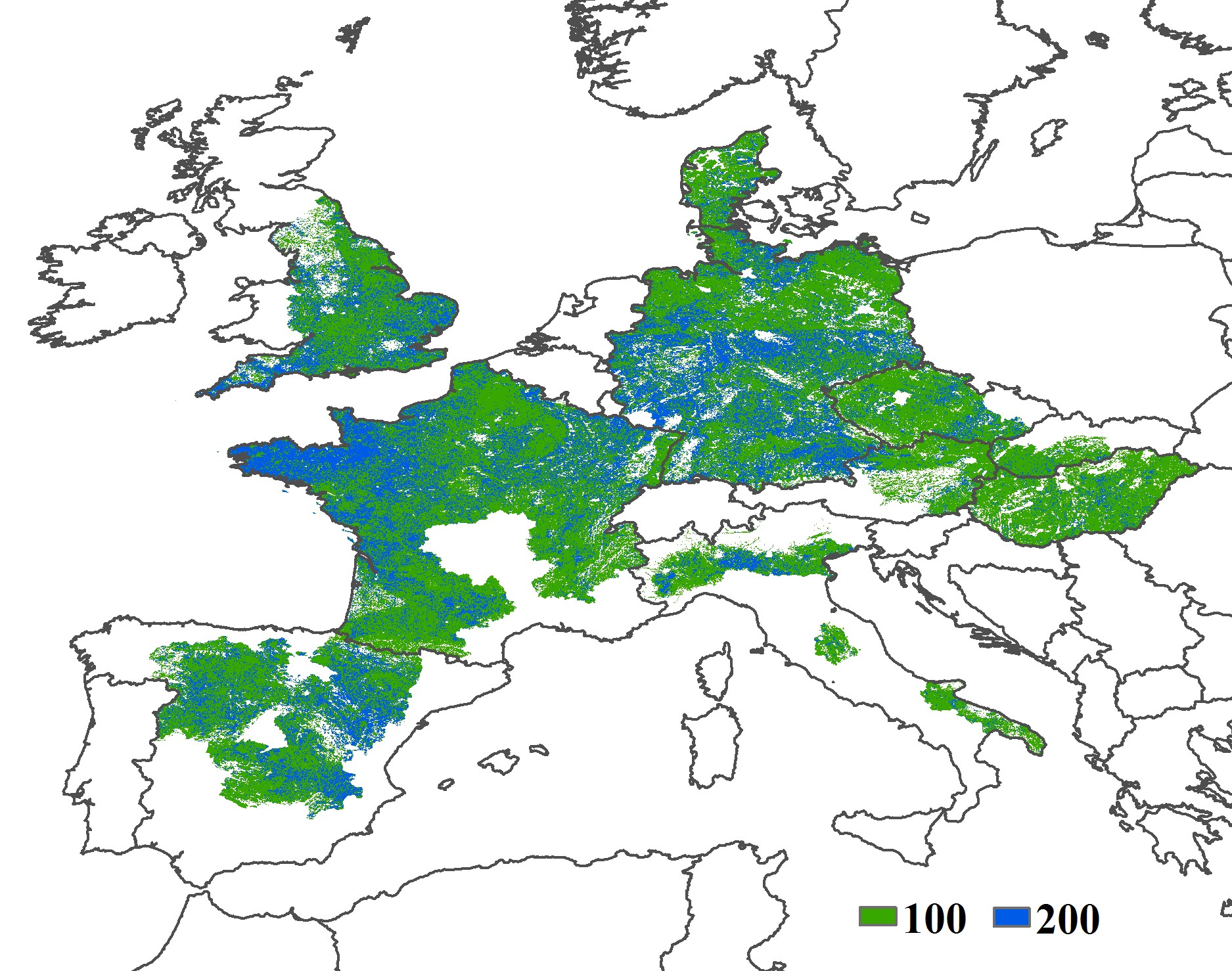
Due to the rainfall deficit and heatwaves, the biomass accumulation potential BIOMSS was 1% below the recent five-year average.The lowest BIOMSS values (-20% and less) occurred in most of France, Spain, and Italy. In contrast, BIOMSS was above average (sometimes exceeding a 10% departure) over most of the United Kingdom, Germany, the Czech Republic, south Slovakia, northeast Austria, and most of Hungary. The average maximum VCI for the MPZ reached a value of 0.80 during this reporting period, indicating favorable crop condition. More than 89% of arable lands were cropped, which is 2% below the recent five-year average. Most uncropped arable land is concentrated in Spain and southeast Italy. Cropping intensity (117%) was down 6% compared with the five-year-average across the MPZ.
Generally, the condition of summer crops in the MPZ was below average, and more rain will be needed to ensure an adequate soil moisture supply for the ongoing winter crop season.
Figure 2.5a. Western Europe MPZ spatial distribution of rainfall profiles (left) and profiles of rainfall departure from average (mm) (right), July-October 2017

Figure 2.5b. Western Europe MPZ spatial distribution of temperature profiles (left) and profiles of temperature departure from average (℃) (right), July-October 2017

Figure 2.5c. Western Europe MPZ maximum VCI, July-October 2017

Figure 2.5d. Western Europe MPZ cropped and uncropped arable land, July-October 2017

Figure 2.5e. Western Europe MPZ biomass accumulation potential departure, July-October 2017

Figure 2.5f. Western Europe MPZ VHI minimum, July-October 2017

Figure 2.5g. Western Europe MPZ cropping intensity, November 2016-October, 2017