English
 中文
中文
Bulletin
CropWatch bulletinMenu
Authors: 超级管理员 | Edit: tanshen
2.7 Central Europe to Western Russia
During the current monitoring period, crop condition showed significant regional disparities over the Central Europe to Western Russia MPZ. Sowing of winter crops was completed under somewhat colder (TEMP, 0.3°C below average) and less sunny (RADPAR, -1%) than average weather, while the abundant rainfall (+11%) improved the condition of soil moisture for the growing of winter crops.
As indicated by the rainfall profiles, the southern part of the MPZ (including Romania, Ukraine, eastern Poland, and southern Russia) shows a rainfall deficit in July and August. In the following two months, rainfall in most regions increased to above average, especially in western Poland and Belarus with three peaks with almost 30% above average rainfall occurring in early September, early October, and late October. Temperature profiles show correlated variations across the whole MPZ, though with the exception of the eastern part (in Russia). The highest temperature (5.5°C above average in mid-September) was recorded for Luhans'ka and Donets'ka of Ukraine and the Oblasts of Rostovskaya and Volgogradskaya as well as the Krasnodarskiy and Stavropolskiy Krays.
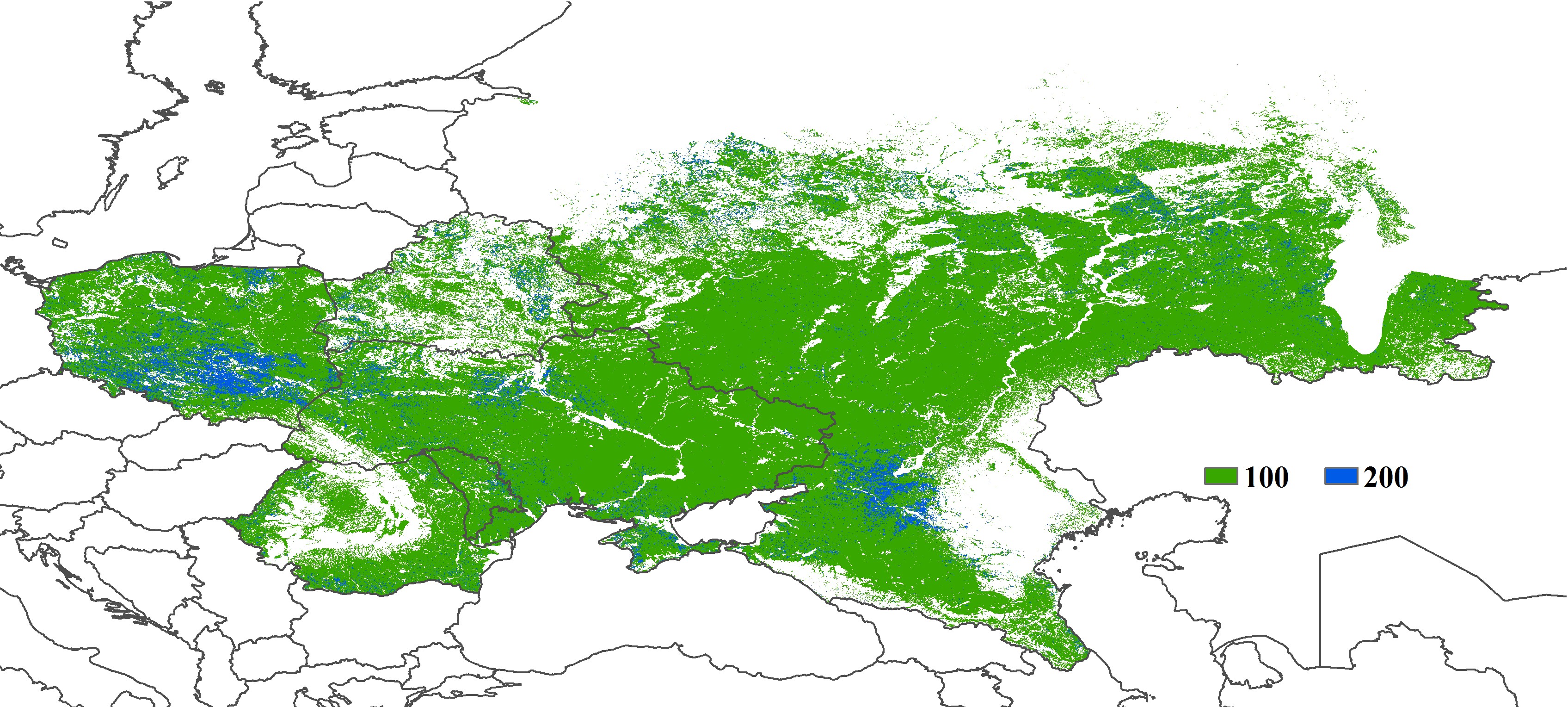
The sufficient rainfall led to a significant increase in potential biomass for the whole MPZ (BIOMSS, +9% compared to the five-year average). The distribution map of the potential biomass, however, showed regional differences, including a large positive biomass departure (BIOMSS more than +20%) in Poland, Belarus, western Ukraine, northern Romania, and most parts in southwestern Russia. In contrast, the eastern Ukraine, as well as the Krasnodarskiy Kray and the Oblast of Saratovskaya showed significant drops in potential biomass. The pattern is consistent with the distribution of VHIn and VCIx. Almost 97% of the arable land was actually cropped during the reporting period (with a CALF of 1% above average). Uncropped land concentrated in Crimea, Khersons'ka, and southwestern Russia, leading to low maximum VCI values (less than 0.5) in these areas. The cropping intensity increased by 2% compared to the recent five-year average. The double cropping area is mainly distributed in southern Poland and southwestern Russia. Generally, with most parts indicating above average crop conditions, prospects for crop production are promising in the Central Europe to Western Russia MPZ.
Figure 2.6a. Central Europe-Western Russia MPZ spatial distribution of rainfall profiles (left) and profiles of rainfall departure from average (mm) (right), July-October 2017

Figure 2.6b. Central Europe-Western Russia MPZ spatial distribution of temperature profiles (left) and profiles of temperature departure from average (mm) (right), July-October 2017

Figure 2.6c. Central Europe-Western Russia MPZ maximum VCI, July-October 2017

Figure 2.6d. Central Europe-Western Russia MPZ cropped and uncropped arable land, July-October 2017

Figure 2.6e. Central Europe-Western Russia MPZ biomass accumulation potential departure, July-October 2017

Figure 2.6f. Central Europe-Western Russia MPZ VHI minimum, July-October 2017

Figure 2.6g. Central Europe-Western Russia MPZ cropping intensity, November 2016-October 2017