
 English
 中文
中文
Bulletin
CropWatch bulletinMenu
Authors: 超级管理员 | Edit: tanshen
The current reporting period covers the planting and growth of Aman rice and the harvesting of Aus rice. The country received heavy rains (2211 mm) exceeding the average by 49%, which did did cause very severe flooding (see also Chapter 5, section on disaster events). Temperature (28.5°C) was just average, while sunshine, measured by RADPAR, was 12% below average, representing a very significant drop for a country where this variable is the main limiting factor for agriculture. The BIOMSS indicator for Bangladesh is up 16% over average. High rainfall, low sunshine, and floods have negatively affected crops. NDVI was very low until August, which corresponded with the maturity of Aus rice; NDVI then picked up to arrive at a level near the five-year average in October, indicating satisfactory conditions for Aman rice. While CALF was only comparable with the five-year average, the VCIx at 0.9 was good. The overall situation during the reporting period was dominated by heavy rains causing floods and so adversely affecting the crop prospects, especially for Aus rice.
Regional analysis
For Bangladesh, four agro-ecological regions are applied, including the Coastal region, the Gangetic Plains, the Hill region, and the Sylhet basin.
The Coastal region received 2094 mm rainfall (+43% compared with average). Temperature was average at 28.5°C (a -0.4°C departure), while RADPAR was much below average (-12%). The region's high BIOMSS value (+16% above the five-year average) is contradicted by lower than average NDVI throughout the period. Meanwhile CALF, at 90%, was just average. The VCIx value of 0.92 indicates a good crop condition for the crops grown during the season. Lower than average production, however, is likely due to excess water and low radiation.
The monsoon rains in the Gangetic Plains (2088 mm) exceeded average by 58%. Similar to the Coastal region, temperature was average and RADPAR was well below (-12%). BIOMSS was expected to be 58% of the five-year average. As reflected in the NDVI graphs, heavy rains have damaged the Aus rice (in particular drying the grain was difficult) and delayed the planting of Aman rice. The rains may have also damaged the planted Aman rice, as as seen in low NDVI for the region until August. The later increase in NDVI to near average indicates that Aman rice could reach average condition. Finally, with a CALF at 95% and a VCIx of 0.96, indicators show that most of the cropland was planted and that the Aman crops attained good condition. Overall, crop prospects are poor for Aus but good for Aman rice.
The Hill region region received 2335 mm of rains, which is +31% above average. Temperature (at 27.1°C) was slightly below average (-0.8°C), while RADPAR underwent a significant drop, being 9% below average. The biomass production prospect of 2612 gDM/m2 was +5% above its five-year average. The NDVI profile for the region also shows low values throughout the crop growing period, indicating that crop condition remained below average. Still, a CALF of 98% and VCIx of 0.95 together indicate that the Hills region may be one of the least affected regions by the generally poor conditions.
The Sylhet basin followed the same pattern as other areas with high rainfall of 2402 mm (52% higher than average). Temperature (28.4°C) was just below average (-0.4°C), while radiation (RADPAR at 743MJ/m2) was the lowest of all for agro-ecological regions down 14% compared with average. The BIOMSS of 2659gDM/m2 for the region represented an increase of 15% over the five-year average. This is, however, contradicted by the low CALF of 86%, confirming that less area could be planted due to floods. Similarly, a VCIx of just 0.84 indicates mixed crop condition. Crop condition development remained poor until mid September, after which it improved, eventually even exceeding the five-year maximum in a case of late recovery. These findings suggest that crop condition for the Aus rice crop was not good, but that the Aman rice crop yield could be better than average, provided agroclimatic indicators remained favorable in November.
Altogether, conditions were poor during July to September due to excessive rainfall, floods, and very low sunshine, although NDVI improved later in the season and particularly in October. Prospects of the already harvested Aus crop are poor. According to the indicators, the condition of the ongoing Aman rice remains fair to good, subject to favorable agroclimatic condition.
Figure 3.7. Bangladesh crop condition, July - October 2017
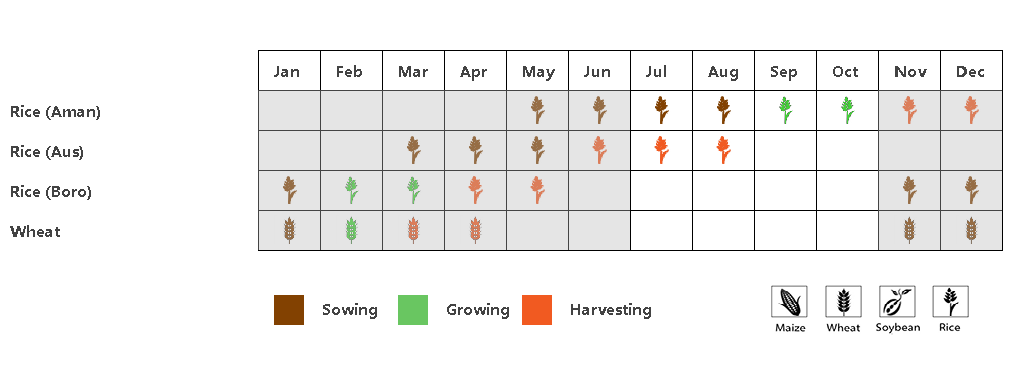
(a). Phenology of major crops

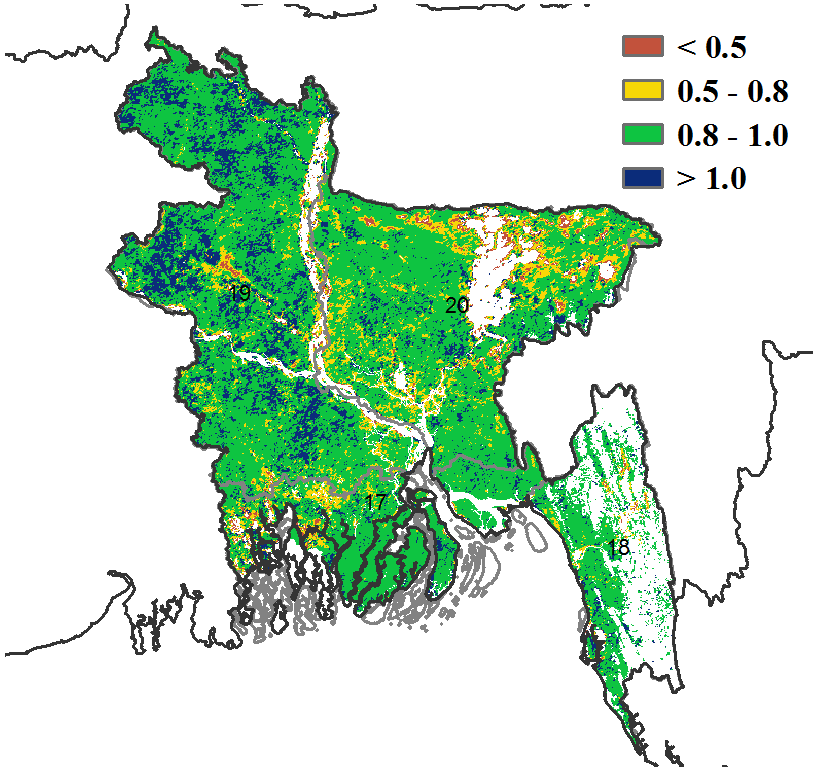
(b) Crop condition development based on NDVI (c) Maximum VCI
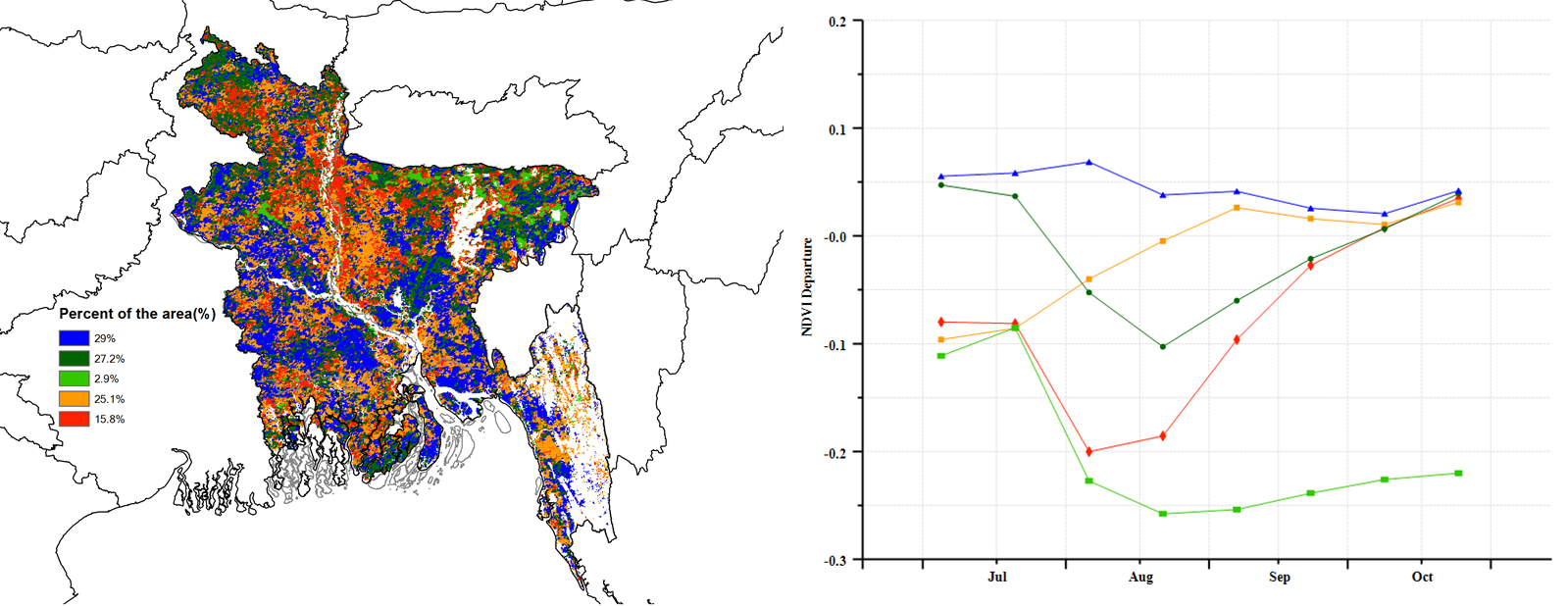
(d) Spatial NDVI patterns compared to 5YA (e) NDVI profiles
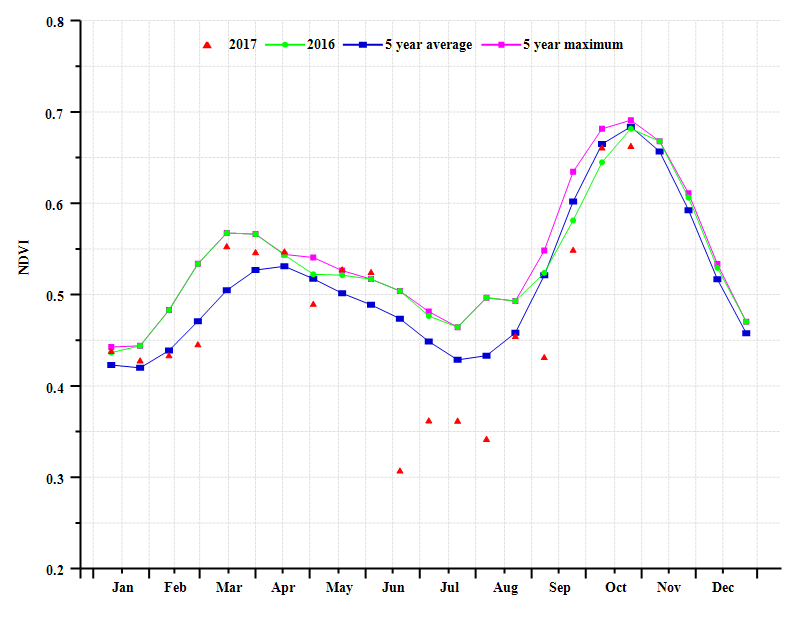
(f) Crop condition development graphs based on NDVI Hill region
(g) Crop condition development graphs based on NDVI Coastal region
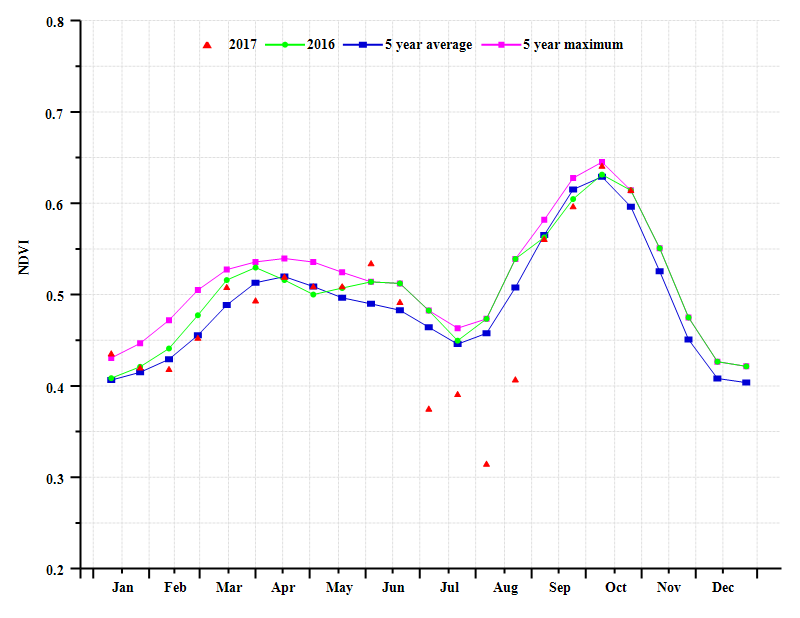
(h) Crop condition development graphs based on NDVI Gangetic region
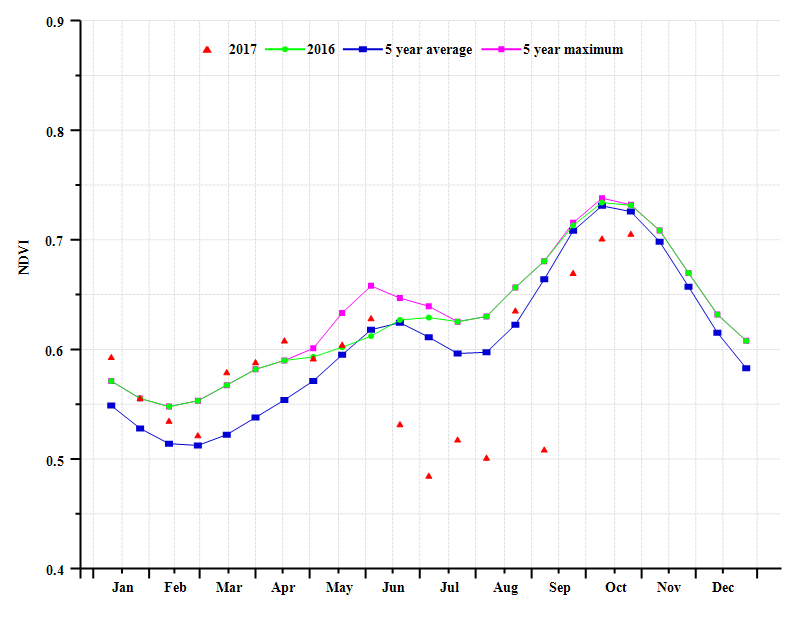
(i) Crop condition development graphs based on NDVI Sylhet basin
Table 3.8 Bangladesh agroclimatic indicators by agro-ecological regions, current season's values and departure from 15YA, July- October, 2017
| RAIN | TEMP | RADPAR | ||||
| Sub-region | Current (mm) | Departure 15Y (%) | Current (°C) | Departure 15YA (°C) | Current (MJ/m2) | Departure 15Y (%) |
| Coastal region (Bangladesh) | 2094 | 43 | 28.7 | 1.0 | 805 | -11 |
| Hill region (Bangladesh) | 2335 | 31 | 27.1 | -0.8 | 795 | -9 |
| Gangatic plain (Bangladesh) | 2088 | 58 | 29.0 | -0.4 | 789 | -12 |
| Sylhet basin (Bangladesh) | 2402 | 52 | 28.4 | -0.5 | 743 | -14 |
Table 3.9 Bangladesh agronomic indicators by agro-ecological regions, current season's values and departure from 15YA, July- October, 2017
| BIOMSS | CALF | VCI | |||
| Sub-region | Current (gDM/m2) | Departure 5Y (%) | Current (%) | Departure from 5YA | Current |
| Coastal region (Bangladesh) | 2613 | 15 | 90 | 0 | 0.92 |
| Hill region (Bangladesh) | 2612 | 5 | 98 | 0 | 0.95 |
| Gangatic plain (Bangladesh) | 2602 | 22 | 95 | 0 | 0.96 |
| Sylhet basin (Bangladesh) | 2659 | 15 | 86 | -1 | 0.84 |
Table 3.10 CropWatch-estimated maize and rice production for Bangladesh in 2017 (thousand tons)
| Production 2016 | Yield variation % | Area variation % | Production 2017 | Production variation % | |
| Maize | 2375 | -5.5% | 0 | 2245 | -0.1 |
| Rice | 47722 | -4.5% | -0.7% | 45274 | -0.1 |