
 English
 中文
中文
Bulletin
CropWatch bulletinMenu
Authors: 超级管理员 | Edit: tanshen
In the Philippines, harvesting of the main season is currently underway. According to the NDVI profiles for the country, crops generally showed unfavorable condition during the current monitoring period. Rainfall was above average (RAIN +12%), accompanied by a slight increase in temperature over average (TEMP +0.7ºC) and somewhat low radiation (RADPAR -3%). The increase in rainfall resulted in BIOMSS being 7% above average.
Based on the VCIx values, favorable crop conditions prevailed as the value mostly exceeded 0.90. VCIx levels by region were 0.95 in the forest region, 0.94 in the hilly agriculture region, and 0.96 in the lowland agriculture region. The cropped arable land fraction (CALF) nation-wide was almost 100%. Considering the spatial patterns of NDVI profiles, 97.7% of the cropped area experienced above average conditions for the entire period, from July to October. Conditions in July, however, suddenly dropped below average, but it cannot be excluded, however, that this drop stems from an unknown artifact or perhaps a typhoon. The Philippines in fact experienced several typhoons, starting with Nesat (also known as Gorio) at the end of July, Hato (Isang) in late August, Doksuri (Marig) in mid-September, and Khanum (Odette) in mid-October (see also Chapter 5, section on disasters). Altogether, the outputs for maize and rice in the country are expected to be about average.
Regional analysis
Based on cropping systems, climatic zones, and topographic conditions, three main agro-ecological regions can be distinguished for the Philippines. They are the lowlands agriculture region, the hilly agriculture region, and the forest region.
The lowlands agriculture region experienced normal rainfall (RAIN +3%) and somewhat weak radiation (RADPAR 2%) and temperature (TEMP -0.6°C). The biomass production potential was +4% compared to the average for the period and region. Regional CALF is 100%, and the VCIx was good at 0.96. Altogether, the outputs for maize and rice are expected to be at least average.
The hilly agriculture region recorded above average rainfall (RAIN, +10%), low radiation (RADPAR -4%), and high temperature (TEMP +1.8°C), leading to an expected biomass production potential (BIOMSS) of about 7% above average. With a CALF of 99% and good VCIx (0.94), the outputs of the maize and rice seasons are expected to be average or slightly below due to the combination of poor sunshine and high temperature.
The highest rainfall departure was recorded for the forest region (RAIN, +28%). Temperature here was normal, as was radiation. BIOMSS is 11% above the five-year average. A high CALF (100%) and good VCIx (0.95) should result in above average maize and main rice seasons.
Figure 3.24. Philippines crop condition, July -October 2017
(a) Phenology of major crops


(b) Crop condition development graph based on NDVI (c)Maximum VCI
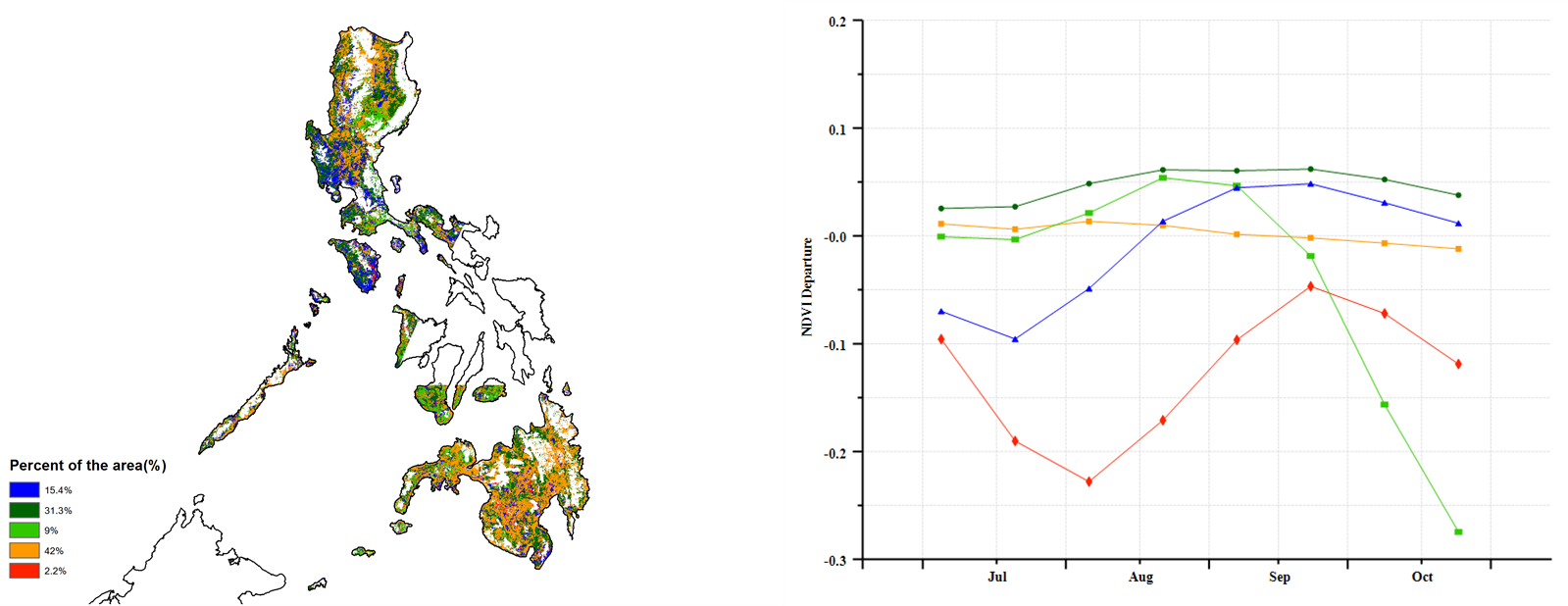
(d) Spatial NDVI patterns compared to 5YA (e) NDVI profiles


(f) Crop condition development graph based on NDVI (Lowland agriculture region (left) and Hilly agriculture region (right))

(g) Crop condition development graph based on NDVI(Forest Region)
Table 3.59.Philippines agroclimatic indicators by agro-ecological region, current season's values and departure from 15YA, July-October 2017
| Region | RAIN | TEMP | RADPAR | |||
| Current (mm) | Departure from 15YA (%) | Current (°C) | Departure from 15YA (°C) | Current (MJ/m2) | Departure from 15YA (%) | |
| Lowland agriculture region | 1465 | 3 | 26.1 | 0.6 | 987 | -2 |
| Hilly agriculture region | 1179 | 10 | 26.7 | 1.8 | 992 | -4 |
| Forest fegion | 1167 | 28 | 26.1 | 0.6 | 1006 | -5 |
Table 3.60.Philippines agronomic indicators by sub-national regions, current season's values and departure from 5YA, July-October 2017
| Region | BIOMSS | Cropped arable land fraction | Maximum VCI | ||
| Current (gDM/m2) | Departure from 5YA (%) | Current | Departure from 5YA (%) | Current | |
| Lowland agriculture region | 2416 | 4 | 1 | 0 | 0.96 |
| Hilly agriculture region | 2471 | 7 | 0.99 | 0 | 0.94 |
| Forest region | 2376 | 11 | 1 | 0 | 0.95 |
Table 3.61.CropWatch-estimated maize and rice production for Philippines in 2017 (thousand tons)
| Crops | Production 2016 | Yield variation | Area variation | Production 2017 | Production variation |
| Maize | 7565 | 0.9% | 0.0% | 7626 | 0.8% |
| Rice | 20106 | 0.5% | -0.1% | 20188 | 0.4% |