
 English
 中文
中文
Bulletin
CropWatch bulletinMenu
Authors: 超级管理员 | Edit: tanshen
In Turkey, most of the maize and rice was harvested during the reporting period, while the planting of winter wheat in the country started in September.
For the country as a whole, rainfall was below average (RAIN -28%), with temperature (TEMP) and radiation (RADPAR) above average by +0.8°C and +3%, respectively. The biomass production potential was below average (BIOMSS -29%) due to unfavorable weather conditions. The maximum VCI (VCIx) for the country was 0.82. Compared with the recent five-year average, the cropped arable land fraction (CALF) and the cropping intensity were above average for Turkey as a whole (CALF +11% and CI +2%).
As shown by the crop condition development graph, national NDVI closely followed the average of the previous five years from July to August, but remained below that average from September to October. The spatial NDVI patterns and NDVI profiles indicate that NDVI values were below average in more than half of croplands over the entire reporting period. Above average values from July to October occur in parts of the Black Sea region and the Marmara-Aegean-Mediterranean region. NDVI values were above average until August, but below average from September to October in some areas of the central Anatolia region. The VCIx map shows that crop condition was not very good in most of the Eastern Anatolia region.
For Turkey, the main crops for the recent reporting period are maize and wheat. For maize, CropWatch puts the production 6.3% above that of the previous season due to an increase in both yield and cropped area (+2.9% and +3.3%, respectively). The smaller increase (+1%) proposed for wheat production results from slightly higher yield (+1.2%) and a small drop in cultivated area (-0.2%).
Regional analysis
The five agro-ecological areas examined more closely for CropWatch include the Black Sea region, the northeast region, the southeast region, central Anatolia, and the Marmara-Aegean-Mediterranean region.
In the Black Sea region, the crop condition was below but close to the recent five-year average. Rainfall was well below average (RAIN -48%), which accounts for the decrease of biomass (BIOMSS -40%). The temperature was closed to average (TEMP +0.5°C). CALF was 96% and the VCIx was 0.90.
Compared with the average, TEMP and RADPAR in the northeast region increased by 1.6°C and 6% respectively, while RAIN decreased 30% compared to average. The region's CALF (+1%) was close to the five-year average. The biomass production potential was below average (BIOMSS, -30%), in direct response to the shortage of rainfall. Consistent with the spatial NDVI patterns, CropWatch estimates bad crop condition for this region.
The southeast region experienced a large deficit in RAIN (-47%) with warm weather (TEMP +1.5°C) and average sunshine. The CALF was low with 24%, while the VCIx was 0.7. The NDVI trend graph showed the crop condition was below average from September to October, and crops in the region are considered to be generally in poor condition.
The central Anatolia region experienced a deficit of RAIN of 24%. Both TEMP and RADPAR, however, were above but close to average. CALF in the region increased by 31%, and the VCIx was 0.88. The NDVI trend line indicated that crop condition was above the five-year average from July to August. Crop production prospects are fair for this region.
The Marmara-Aegean-Mediterranean region had the smallest rainfall deficit in the country (-14%), but temperature and radiation were average. CALF was above average (+6%), and the VCIx was 0.78. In the NDVI trend graph, the crop condition was above the recent five-year average from July to August and close to that average from September to October.
Figure 3.29. Turkey crop condition, July-October 2017
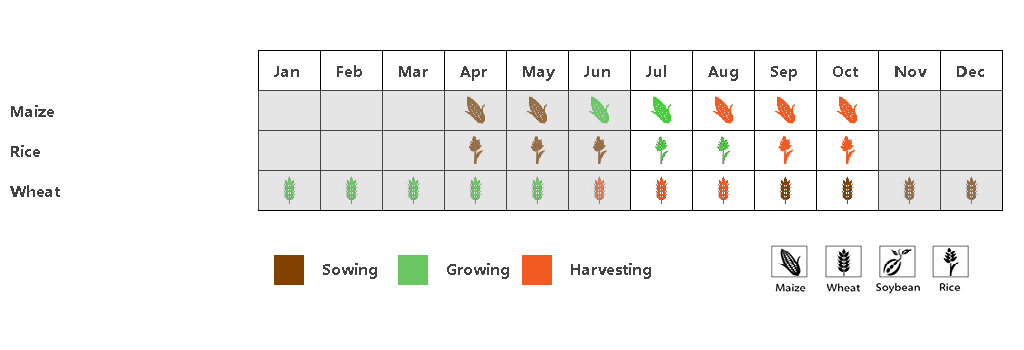
(a) Phenology of major crops

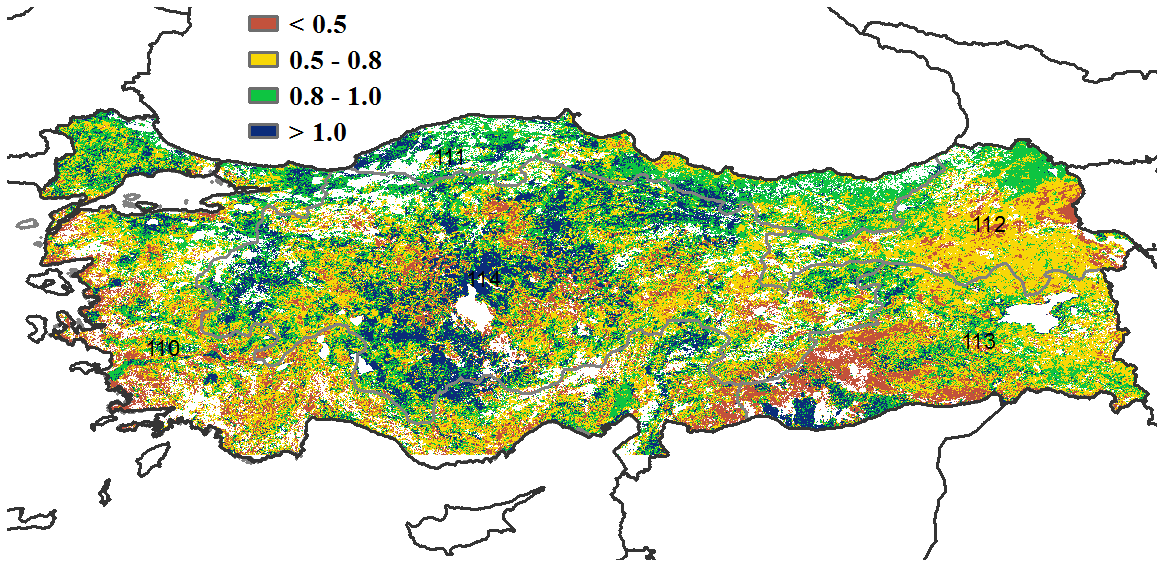
(b) Crop condition development graph basedon NDVI (c) Maximum VCI

(d) Spatial NDVI patterns compared to 5YA (e) NDVI profiles
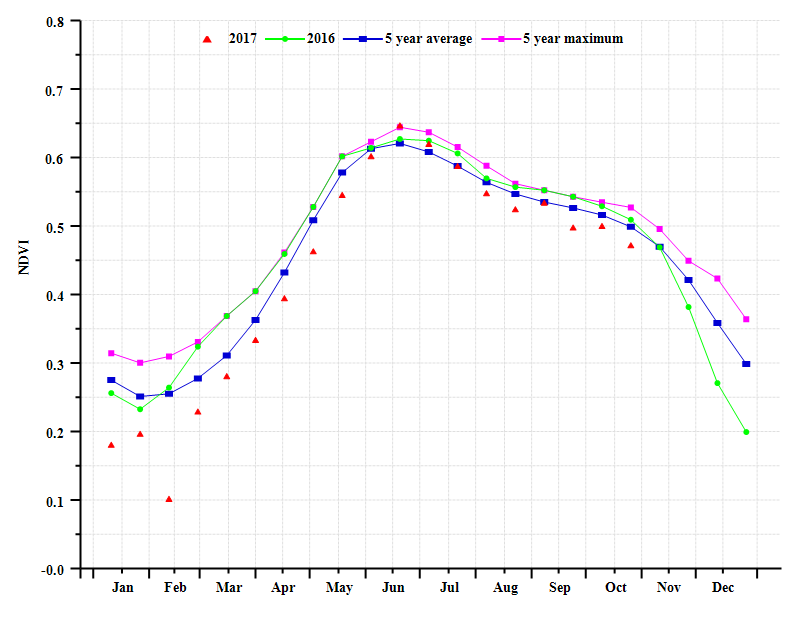

(f) Crop condition development graph based on NDVI (Black Sea region (left) and North East region (right))
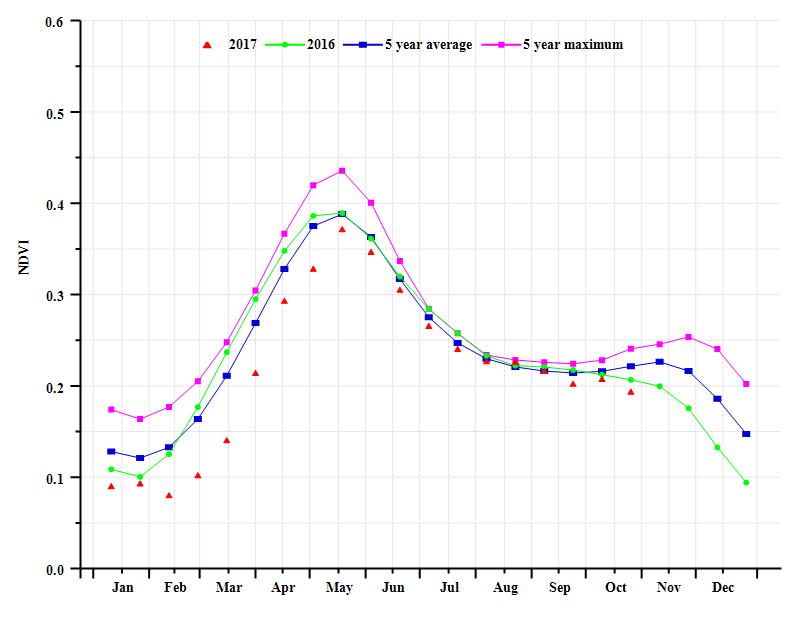
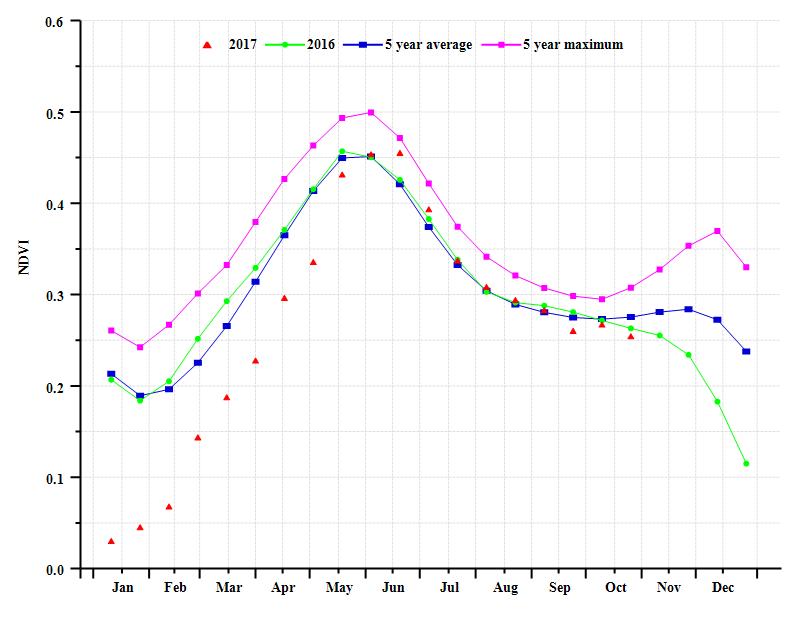
(g) Crop condition development graph basedon NDVI (South East region (left) and Central Anatolia region (right))

(h) Crop condition development graph basedon NDVI (Marmara_Agean_Mediterranean region (right))
Table 3.74.Turkey agroclimatic indicators by agro-ecological region, current season's values and departure from 15YA, July-October 2017
| Region | RAIN | TEMP | RADPAR | |||
| Current (mm) | Departure from 15YA (%) | TEMP (℃) | Departure from 15YA (℃) | Current (MJ/㎡) | Departure from 15YA (%) | |
| Black Sea region | 108 | -48 | 18.6 | 0.5 | 1061 | 3 |
| Northeast region | 131 | -30 | 16.0 | 1.6 | 1223 | 6 |
| Southeast region | 43 | -47 | 23.7 | 1.5 | 1329 | 2 |
| Central Anatolia region | 80 | -24 | 19.5 | 0.6 | 1264 | 3 |
| Marmara-Agean-Mediterranean region | 112 | -14 | 21.8 | 0.4 | 1257 | 2 |
Table 3.75. Turkey agronomic indicators by agro-ecological region, current season's values and departure from 5YA, July-October 2017
| Region | BIOMSS | CALF | Maximum VCI | ||
| Current (gDM/㎡) | Departure from 5YA (%) | Current (%) | Departure from 5YA (%) | Current | |
| Black Sea region | 462 | -40 | 96 | 3 | 0.90 |
| Northeast region | 520 | -30 | 68 | 1 | 0.73 |
| Southeast region | 202 | -42 | 24 | 2 | 0.74 |
| Central Anatolia region | 320 | -28 | 39 | 31 | 0.88 |
| Marmara-Agean-Mediterranean region | 391 | -20 | 59 | 6 | 0.78 |
Table 3.76. CropWatch-estimated maize and wheat production for Turkey in 2017 (thousand tons)
| Crops | Production 2016 | Yield variation (%) | Area variation (%) | Production 2017 | Production variation (%) |
| Maize | 5920 | 2.9 | 3.3 | 6294 | 6.3 |
| Wheat | 18981 | 1.2 | -0.2 | 19174 | 1.0 |