
 English
 中文
中文
Bulletin
CropWatch bulletinMenu
- Overview
- Country analysis
- Argentina
- Australia
- Bangladesh
- Brazil
- Canada
- Germany
- Egypt
- Ethiopia
- France
- United Kingdom
- Indonesia
- India
- Iran
- Kazakhstan
- Cambodia
- Mexico
- Myanmar
- Nigeria
- Pakistan
- Philippines
- Poland
- Romania
- Russia
- Thailand
- Turkey
- Ukraine
- United States
- Uzbekistan
- Vietnam
- South Africa
- Afghanistan
- Belarus
- Mongolia
- Sri Lanka
- Zambia
- Mozambique
- Kenya
- Angola
- Hungary
- Italy
- Morocco
Authors: 超级管理员 | Edit: Miao
The reporting period marks the end of the main harvesting season throughout the region for maize, sorghum, millet, and yams, with cereal production expected to be above average as reflected by the cropping intensity of 132 (5YA Departure: +3%) strongly influenced by the seasonal rainfall variation. The north of the MPZ, receiving a unimodal rainy season, has most of its cultivated cereals under harvesting. In the western MPZ covering Guinea to Liberia, the rice crop harvesting extends into December and January. The MPZ area experiencing bimodal rainfall (southern Côte d'Ivoire to Nigeria) harvested its first crop in October, while the short season maize will be harvested in January 2018. Cassava, the main staple in this region is reflected in the current cropped arable land area as the crop is still in the fields growing.
The CropWatch observations indicated an average rainfall 1004 mm with an overall increase above average (+18% for RAIN), with average temperature of 25.9°C (-0.6°C departure) and sunshine (RADPAR=1139 MJ/m2, +7%), which resulted in a slight decrease in biomass production potential (BIOMSS=1825gDM/m2, 5YA Departure: -2%). However, the coastal regions of Cote I'voire, Ghana, Benin and Togo as well as parts of western Nigeria experienced a positive departure (>20%) in biomass as compared to the whole region (<20%). A more pronounced BIOMSS negative departure was observed in Guinea Bissau, Guinea, Sierra Leon and Eastern Nigeria (-20 to 0%). The increase of precipitation above average in the west of the region, resulted in improved river flow in the Niger catchment and irrigated crops in the Sahel (in Niger, the flow peaks between December and March, according to the years).
For most of the MPZ, the cropped arable land fraction (CALF) reached 96% while the VCIx map as index of crop condition showed average VCIx of 0.93. These climatic conditions were favorable across the region with northern Nigeria showing a good share of cropped arable land.
Precipitation was well distributed in time and space, temperature fluctuating within a +/-2°C margin after cessation of the rainy season. Based on these observations CropWatch indicators depict a stable and coherent climatic condition for late crop harvests.

Figure a: Spatial distribution of rainfall profiles

Figure b: Spatial distribution of temperature profiles

Figure c: Cropped and uncropped arable land

Figure d: Potential biomass departure from 5YA

Figure e: Maximum VCI
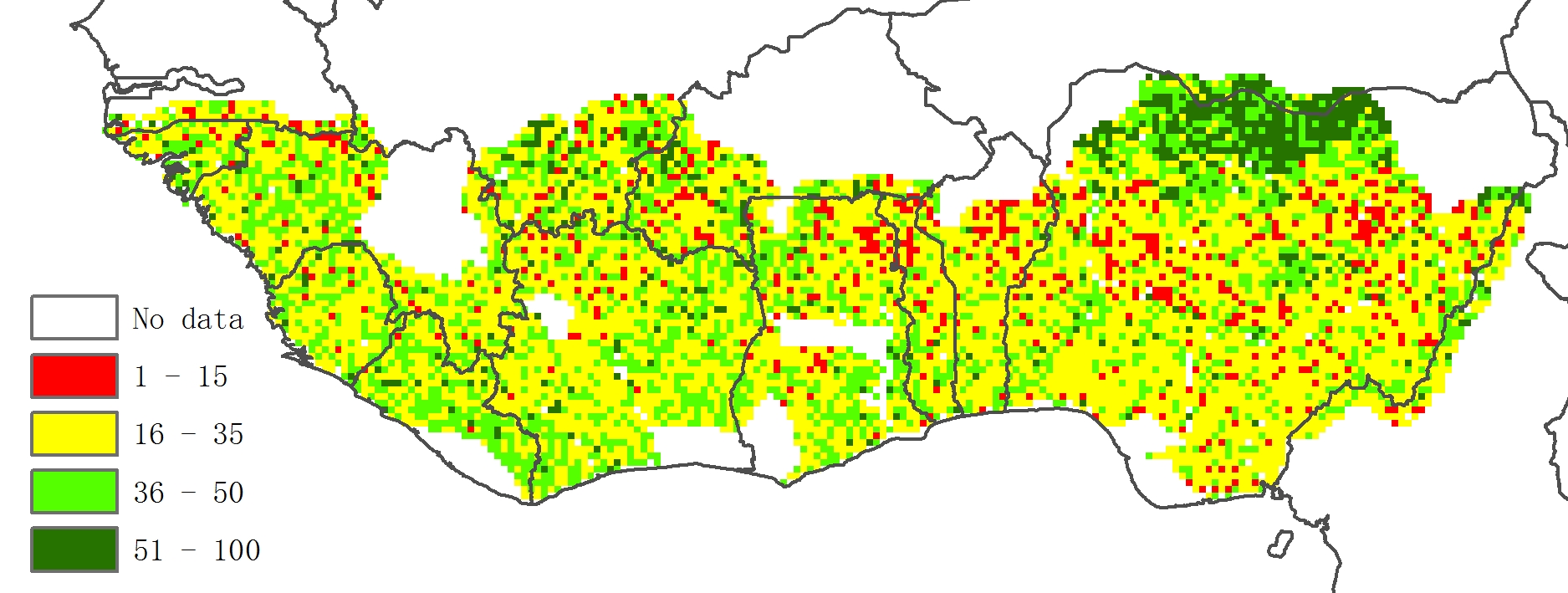
Figure f: VHImin
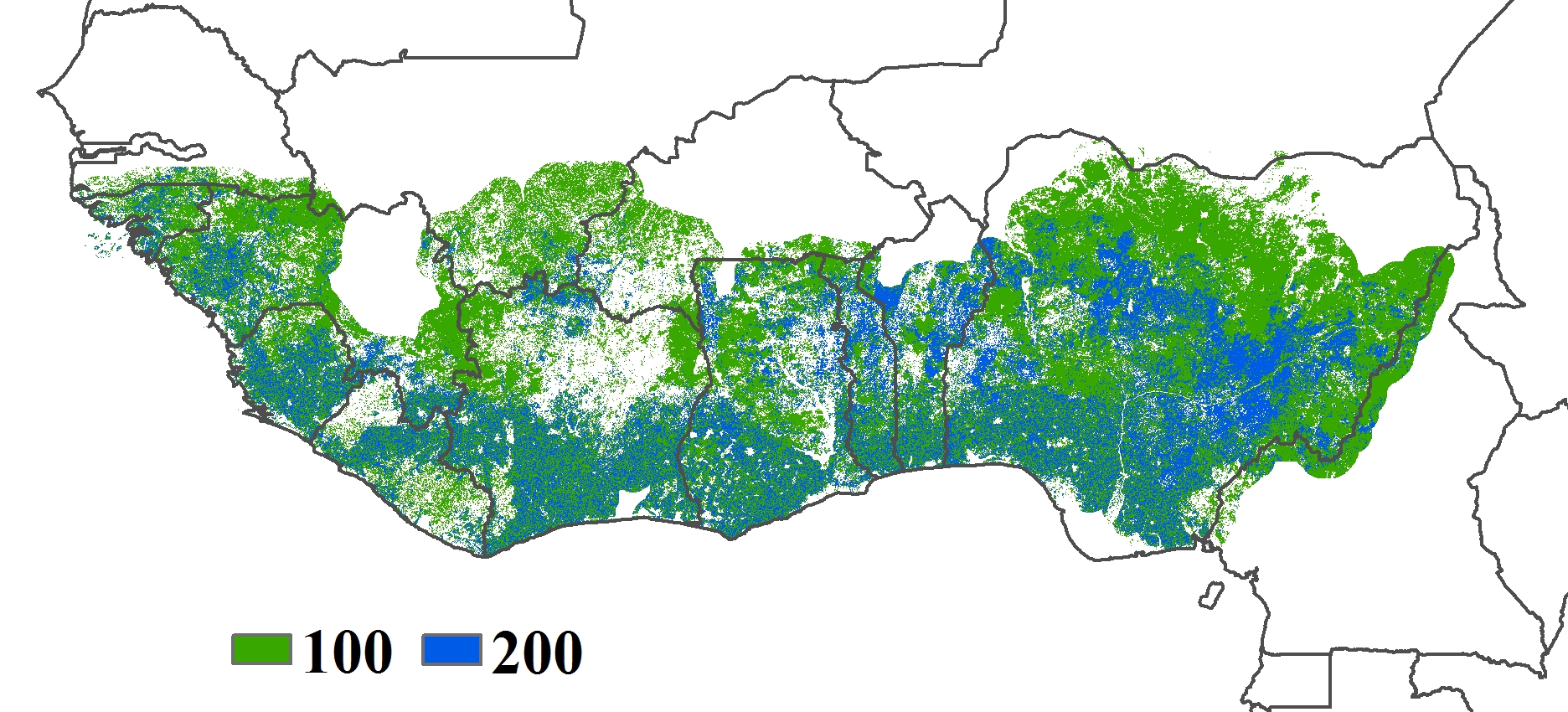
Figure g: Cropping Intensity