
 English
 中文
中文
Bulletin
CropWatch bulletinMenu
- Overview
- Country analysis
- Argentina
- Australia
- Bangladesh
- Brazil
- Canada
- Germany
- Egypt
- Ethiopia
- France
- United Kingdom
- Indonesia
- India
- Iran
- Kazakhstan
- Cambodia
- Mexico
- Myanmar
- Nigeria
- Pakistan
- Philippines
- Poland
- Romania
- Russia
- Thailand
- Turkey
- Ukraine
- United States
- Uzbekistan
- Vietnam
- South Africa
- Afghanistan
- Belarus
- Mongolia
- Sri Lanka
- Zambia
- Mozambique
- Kenya
- Angola
- Hungary
- Italy
- Morocco
Authors: 超级管理员 | Edit: Miao
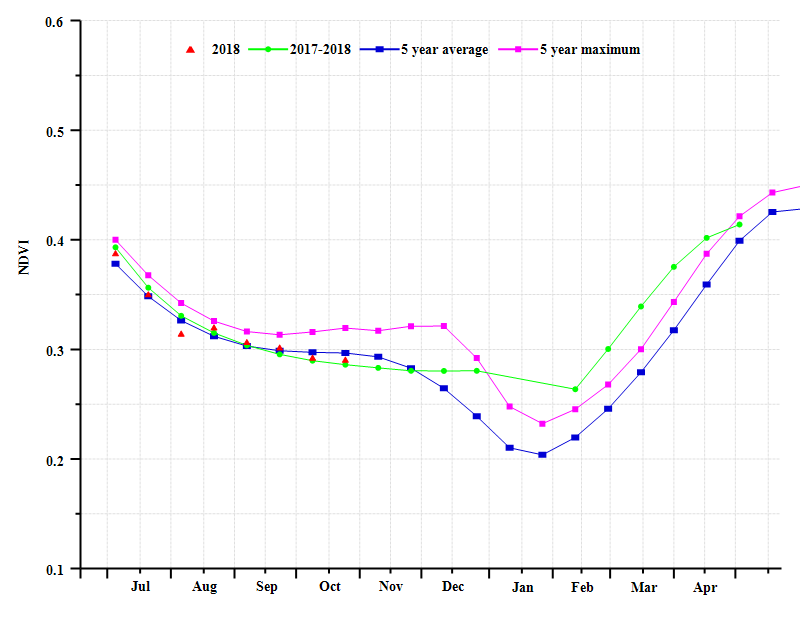
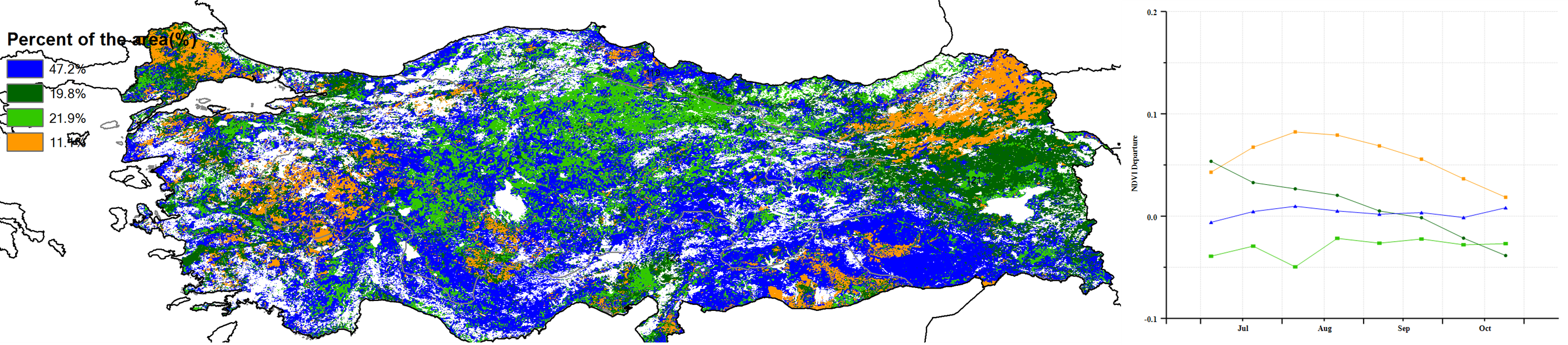
In the whole country, the reporting period covers the harvest of winter wheat, growth and harvest of maize and rice, and the planting of 2018-19 winter wheat from September to October. During the monitoring period, the NDVI was above the previous five-year average, except for early August and October. This shows favourable conditions in Turkey. Weather was very close to average with rainfall just above average (RAIN, +5%), favourable temperature (current TEMP, 20.3℃). Both the cropped arable land fraction and biomass were above average (CALF, +10%; BIOMSS, +53%). The maximum VCI (VCIx) reached 0.83 and the cropping intensity increased by 58%. According to the spatial NDVI patterns map, the NDVI was above average in the provinces or Kars, Aldahan, Erzurum, Edirne, Kırklareli and Tekirdag.
CropWatch estimates the maize production in 2018 to be 4.1% above 2017. The maize yield and area increased by 2.5% and 1.6%, respectively. For wheat, CropWatch puts the yield and area 3.1% and 0.3% above the 2017 value, respectively. The wheat production is, therefore, estimated to be 3.4% above 2017.
Regional analysis
The regional analysis cover four agro-ecological zones (AEZ): the Black Sea area, Central Anatolia, Eastern Anatolia and Marmara Aegean Mediterranean lowland zone.
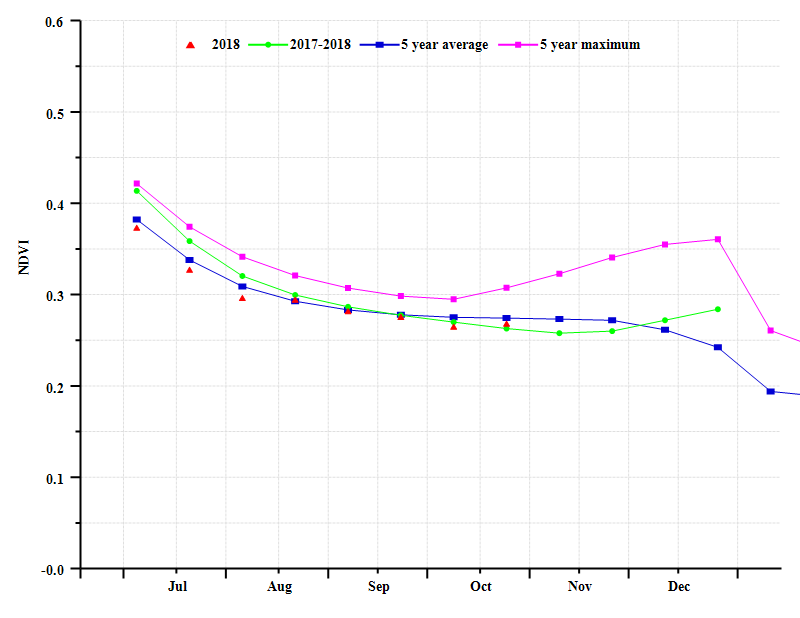
In the Black Sea zone, crop condition was generally below or close to average. Rainfall was short by 12% but sunshine and temperature were average (RADPAR, +2%; TEMP, +1.0℃). The cropped arable land fraction (CALF) was 98%, close to average and up +1%. The VCIx was 0.85. CropWatch estimates the output of crops to be average in this zone.
The Central Anatolian region had below average NDVI in July and October, but average in August and September. The rainfall was above average (RAIN, +19%); radiation and temperature were average (RADPAR,+1%; TEMP, +0.3℃). CropWatch estimates the crop conditions were below or close to average based on the NDVI profile in the Central Anatolian zone, which was also confirmed by the spatial NDVI patterns in this zone.
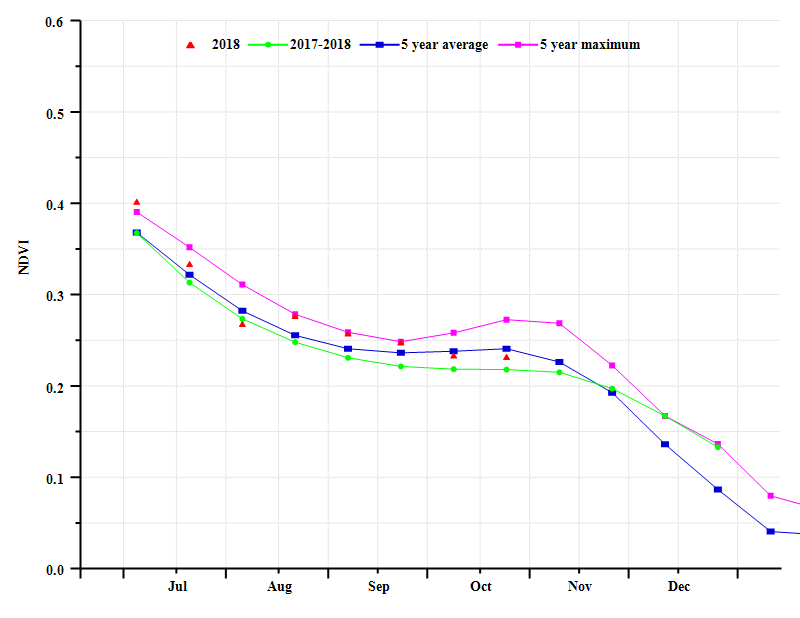
In the Eastern Anatolian plateau, crop condition was above or close to average. The VCIx map shows that most of this region enjoyed higher VCIx than 1.0. The excellent crop condition is also confirmed by the spatial NDVI patterns map. The biomass and cropped arable land fraction were both well above average (BIOMSS, +20%; CALF,+31%). The production of crops is expected to be favorable.
As indicated by the NDVI profile in the Marmara Aegean Mediterranean lowland zone, the crop condition was above or close to average during the reporting period. The abundant rainfall (RAIN, +13%) resulted in increased biomass and cropped arable land fraction (BIOMSS, +61%; CALF,+9%). In this region, the VCIx was 0.88. Good crop production is predicted by CropWatch.
Figure 3.29. Turkey crop condition, July 2018-October 2018.

(a)Phenology of major crops

(b) Crop condition development graph based on NDVI (c) Maximum VCI
(d) Spatial NDVI patterns compared to 5YA (e) NDVI profiles

(f) Crop condition development graph based on NDVI (Black Sea region (left) and Central Anatolia region (right))

(g) Crop condition development graph based on NDVI (Eastern Anatolia region (left) and Marmara_Agean_Mediterranean lowland region (right))
Table 3.74. Turkey agroclimatic indicators by sub-national regions, current season's values and departure from 15YA, July 2018-October 2018.
| Region | RAIN | TEMP | RADPAR | |||
| Current(mm) | Departure from 15 YA (%) | TEMP(℃) | Departure from 15 YA (℃) | Current(MJ/㎡) | Departure from 15 YA (%) | |
| Black Sea region | 172 | -12 | 19.1 | 1.0 | 1123 | 2 |
| Central Anatolia region | 121 | 19 | 19.3 | 0.3 | 1291 | 1 |
| Eastern Anatolia region | 113 | -13 | 19.0 | 0.9 | 1340 | 1 |
| Marmara Agean Mediterranean lowland region | 138 | 13 | 22.4 | 0.4 | 1297 | -2 |
Table 3.75. Turkey agronomic indicators by sub-national regions, current season's values and departurefrom 5YA, July 2018-October 2018.
| Region | BIOMSS | CALF | Maximum VCI | ||
| Current(gDM/㎡) | Departure from 5YA (%) | Current(%) | Departure from 5YA(%) | Current | |
| Black Sea region | 1020 | 26 | 95 | 1 | 0.85 |
| Central Anatolia region | 989 | 79 | 31 | -1 | 0.70 |
| Eastern Anatolia region | 733 | 20 | 58 | 31 | 0.02 |
| Marmara Agean Mediterranean lowland region | 813 | 61 | 58 | 9 | 0.88 |
Table 3.76 CropWatch estimated wheat production for Tuekey in 2018 (thousands tons)
| Crops | Production 2017 | Yield variation(%) | Area variation(%) | Production 2018 | Production variation(%) |
| Maize | 6294 | 2.5 | 1.6 | 6550 | 4.1 |
| Wheat | 19174 | 3.1 | 0.3 | 19829 | 3.4 |